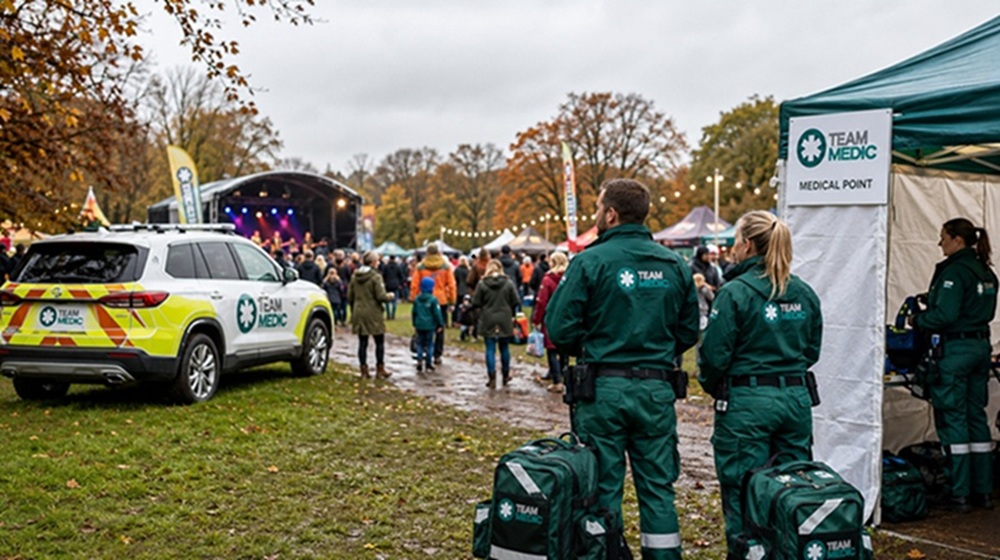
Autumn event medical cover is the planned provision of trained medical personnel, suitable equipment, treatment facilities and emergency-response procedures for an event held during the autumn months.
The right level of cover depends on your attendance, activities, venue layout, weather exposure, accessibility requirements and emergency access-not attendance alone. Wet or uneven ground, falling temperatures, reduced daylight and changing crowd conditions can all affect how quickly medical help reaches someone who needs it.
Planning principle: Medical provision should be proportionate to your event’s actual risks, practical to deploy on the day and integrated with your wider event-safety plan.
Why autumn events need different planning
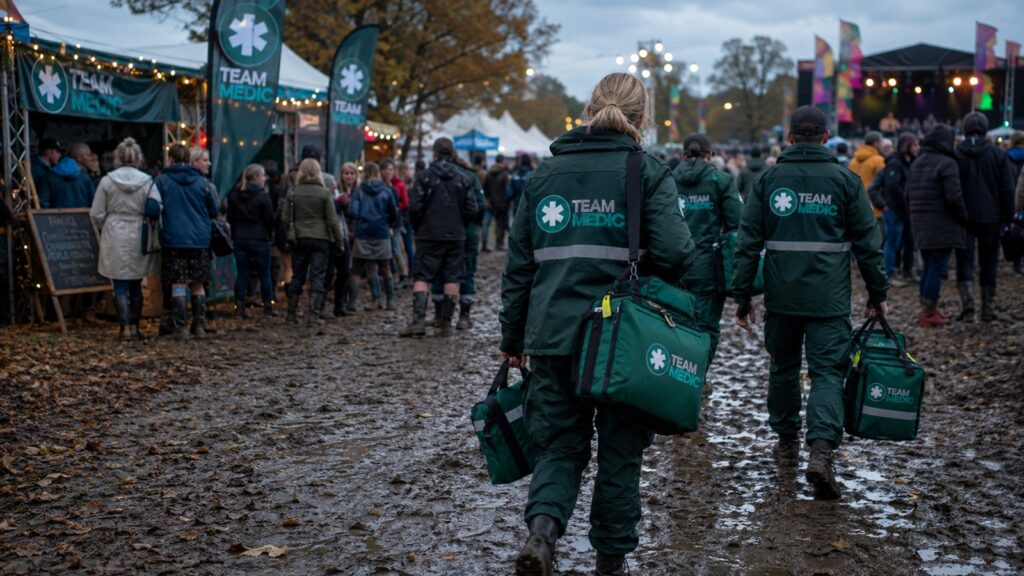
An outdoor event can have a very different risk profile in September, October or November compared with summer. Rain may turn grass into mud, evening temperatures can fall quickly and early darkness can make hazards and emergency routes harder to identify.
Your plan should cover the complete event lifecycle:
Site setup and supplier access.
Attendee arrival and queuing.
Peak attendance.
Evening programming.
Participant activity.
Event dispersal.
Breakdown and late-night departures.
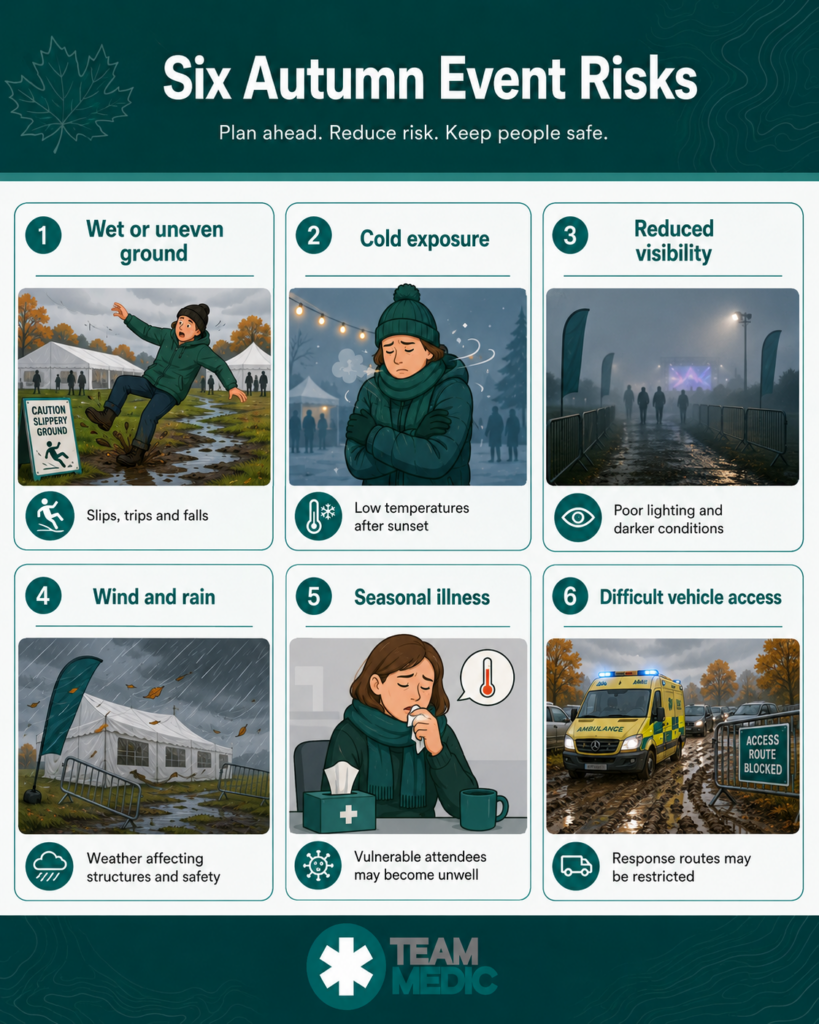
Important autumn-specific risk factors include:
Wet or uneven ground, increasing slips, trips and falls.
Cold exposure, especially after sunset or during prolonged outdoor activity.
Reduced visibility, affecting pedestrians, vehicles and responders.
Wind and rain, which can affect marquees, stages, barriers and temporary flooring.
Seasonal illness, particularly among vulnerable attendees.
Difficult vehicle access, where mud, congestion or soft ground restrict response routes.
Long periods outdoors, causing fatigue, discomfort or dehydration.
A reliable plan prepares for common incidents while also establishing clear procedures for serious emergencies. Everyone with a safety role should understand how to request medical help, communicate a casualty’s location and support the response.
What is autumn event medical cover?
Autumn event medical cover is the event-specific arrangement of clinical staff, equipment, treatment facilities and response procedures needed to manage illness or injury on an autumn event site.
Communications with event control, security and emergency services.
The exact provision should be based on the event’s circumstances. A small event with contact sport, remote terrain or difficult access may require more specialist support than a larger, low-risk indoor gathering.
How much medical cover do you need?
There is no single staffing level that suits every autumn event; provision should be based on a proportionate needs assessment.
Planning factor
Questions to consider
Attendance
What is the peak on-site population, including staff, participants and contractors?
Audience
Will infants, older adults or vulnerable people attend?
Activities
Could the event involve falls, collisions, intoxication, burns or sudden illness?
Venue
Is the site large, remote, uneven, steep or divided into separate areas?
Weather
Could rain, wind, cold or darkness affect safety and access?
Response
How quickly can medical teams reach, treat and transfer a casualty?
Attendance and audience profile
Start with the number of people likely to be on site at the busiest time, rather than relying only on total tickets sold or daily footfall.
Consider:
Expected peak attendance.
Staff, volunteers, performers and contractors.
Arrival and departure surges.
Event duration.
Evening or overnight activity.
Alcohol availability.
The age and health profile of attendees.
Whether people will camp or remain outdoors for long periods.
A daytime village fête with families and older residents creates different medical demands from a late-night festival with alcohol, dense crowds and muddy terrain.
Activities and event hazards
The event label alone does not determine risk. A “community fair” might include inflatables, animals, vehicle displays, cooking demonstrations and a charity race. A “music festival” might involve several stages, camping, bars and high-density viewing areas.
Assess the potential for:
Falls, collisions and impact injuries.
Contact sports and high-speed activity.
Head injuries or suspected concussion.
Burns, cuts and food-related incidents.
Alcohol- or substance-related illness.
Fainting, anxiety and altered consciousness.
Cold or wet exposure.
Fireworks, generators and temporary electrics.
Animal or vehicle-related incidents.
Incidents in remote or poorly lit areas.
Your provider should understand what will actually happen on site, where it will happen and when risk is likely to be highest.
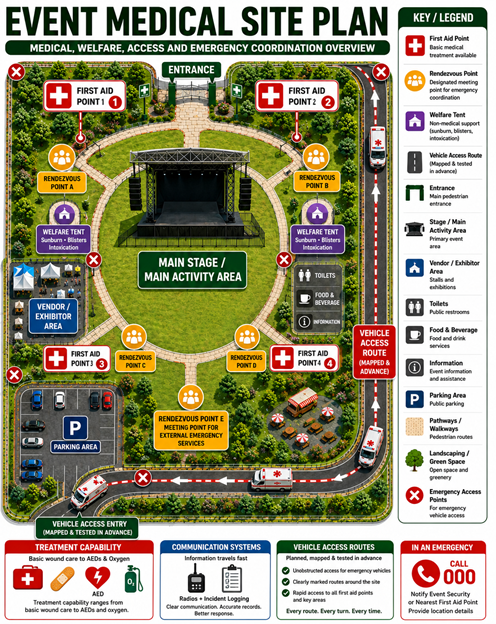
Event Medical Site Plan
Venue layout and emergency access
Medical cover is only effective when responders can reach people quickly. A medical post beside the main entrance may not be enough if the site is large, divided by barriers or difficult to cross.
Map:
Entrances, exits and emergency gates.
Vehicle access and turning areas.
Stages, pitches, tracks and activity zones.
Food, bar, toilet and queueing areas.
Parking, drop-off and public-transport points.
Slopes, steps, bridges, woodland and water.
Areas likely to become muddy or slippery.
Suitable medical-post and welfare locations.
Ambulance rendezvous points.
Routes that must remain clear.
Walk the site after rain if possible. A route that looks suitable in dry conditions may become unusable for wheelchairs, buggies, stretchers or response vehicles.
A medical provider should be told about the terrain and likely weather exposure before recommending equipment or responder positioning.
Accessibility and vulnerable attendees
Accessibility should be built into the site and medical plan from the start. Wet grass, gravel, steep slopes and slippery temporary ramps can create significant barriers for wheelchair users, people with walking difficulties and families using pushchairs.
Check for:
Firm routes between key areas.
Step-free access wherever reasonably possible.
Clear signage to medical and welfare facilities.
Adequate lighting after dark.
Accessible toilets and rest areas.
Seating and shelter.
Communication options for people with hearing, sight or speech impairments.
A process for supporting lost children and vulnerable adults.
Emergency routes that remain clear of stalls, vehicles and queues.
Accessible routes often improve response times for everyone.
Site-testing tip: Test essential routes with a wheelchair, buggy and response vehicle before the event. Do not assume a route will remain accessible after sustained rain.
Autumn event medical cover for music festivals
Autumn music festivals can combine dense crowds, long operating hours, evening performances, alcohol, camping and difficult ground conditions. Multiple stages and remote areas can also make it harder to identify a casualty’s location.
Mud, slick terrain and responder access
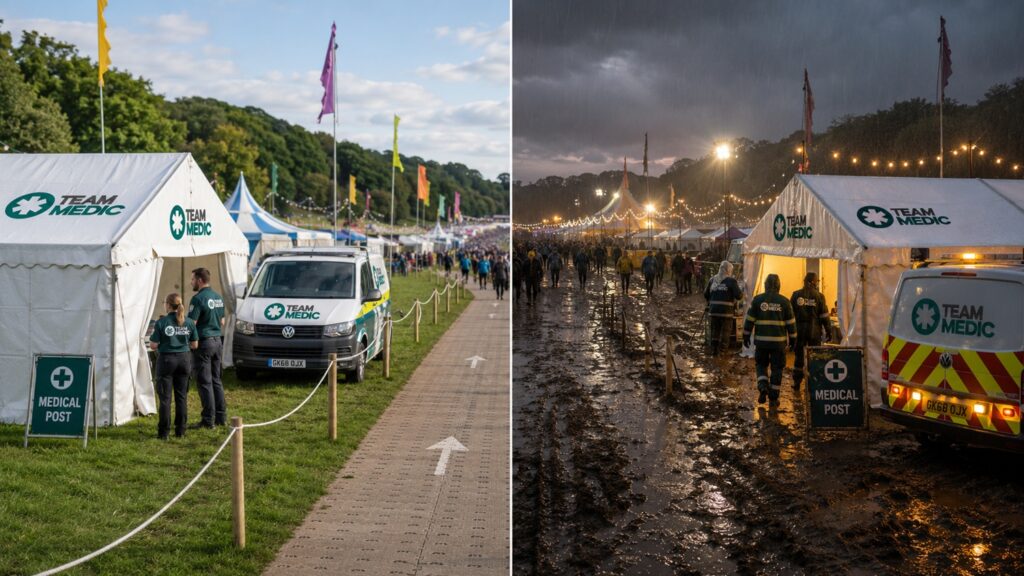
Rain can affect access roads, camping fields, stage areas, queues and car parks. Muddy slopes and slippery walkways may increase falls and slow medical response.
Pay particular attention to:
Front-of-stage and barrier areas.
Routes between stages.
Camping zones.
Food, bar and toilet queues.
Car parks and drop-off points.
Remote stages and activations.
Slopes, gateways and narrow paths.
Agree protected emergency routes with the medical provider and site team. Keep them clear of equipment, stock, parked vehicles, queues and temporary structures.
If the ground deteriorates, organisers may need to install trackway, restrict vehicles, adjust pedestrian routes or close unsafe areas. Medical teams should be part of those decisions because changes to access directly affect response times.
Temperature drops during evening sets
Festival attendees may arrive in light clothing and remain outside until late at night. Rain, wind, fatigue and alcohol can increase vulnerability to cold-related illness.
Plan for:
Warm and sheltered treatment areas.
Lighting around the medical post.
Welfare spaces for people needing warmth or reassurance.
Clear advice about waterproof layers and suitable footwear.
Safe routes between camping, performance and welfare areas.
Monitoring of people who appear confused, exhausted or unusually cold.
Volunteers, security staff, contractors and performers may also spend long periods outside and should not be overlooked.
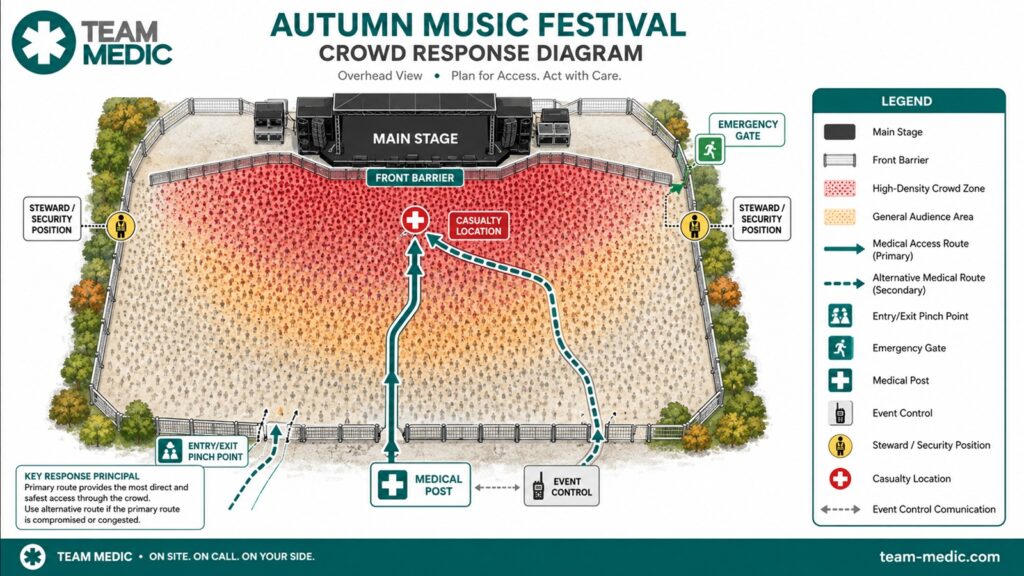
Crowd density tracking
Crowd conditions can change rapidly before a popular set, during a headline performance or as attendees leave. Medical teams need timely information about pressure points and safe ways to enter dense areas.
Identify:
High-density stage-front zones.
Barrier areas.
Entry and exit pinch points.
Queues that may obstruct response routes.
Locations where crowd movement could stop.
Alternative routes for medical personnel.
Clear landmarks for reporting casualty locations.
Medical, security, stewarding and event-control teams should share a communications plan. A useful call for help should identify the stage, zone, gate, landmark or nearest emergency access point.
Medical staff should be able to assess whether a person needs immediate treatment, observation, welfare support, safeguarding intervention or onward transfer. That clinical assessment begins with a structured primary survey to identify and treat immediate threats to life.
Autumn event medical cover for sporting events
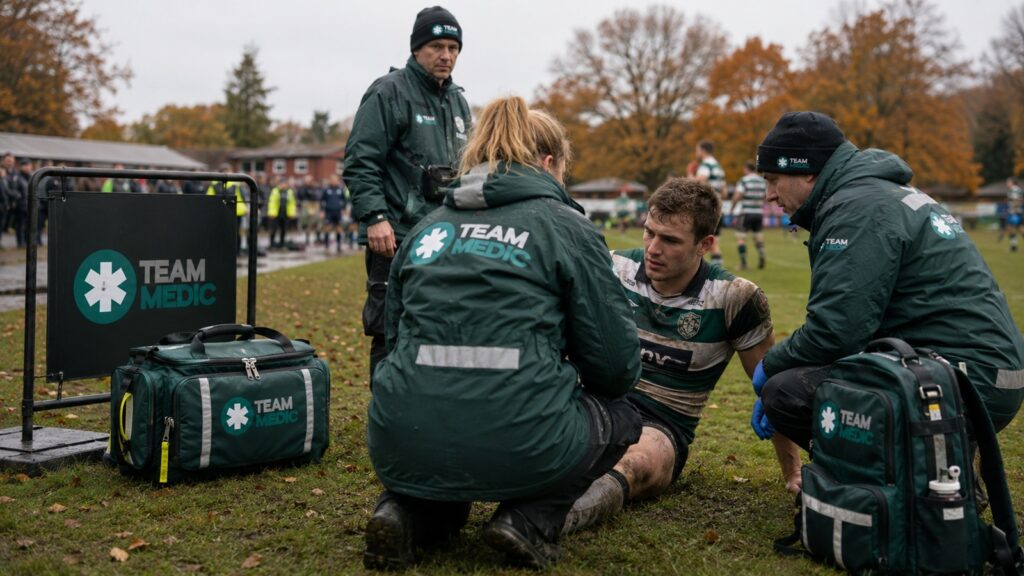
Autumn sporting events may include football, rugby, cross-country, cycling, athletics, motorsport or charity races. Participants can sustain acute injuries, while spectators, officials and volunteers face separate risks from rain, cold and prolonged outdoor exposure. Sporting organisers can also explore Team Medic’s pitch-side medical support for more activity-specific considerations.
Acute trauma and participant injuries
Depending on the activity, credible incidents may include:
Sprains, dislocations and suspected fractures.
Cuts and soft-tissue injuries.
Head injuries and suspected concussion.
Collisions and falls.
Sudden collapse.
Musculoskeletal injuries on slippery surfaces.
Bicycle or vehicle-related trauma.
Severe fatigue or dehydration.
Medical teams should be positioned where incidents are most likely to occur. A pitch-side, track-side or mobile response team may be more appropriate than relying entirely on a distant central post.
Course marshals, officials and coaches should know how to summon help and communicate a precise location. Remote courses may require mobile equipment and a clear extraction plan.
Athlete and spectator medical access
Participants and spectators often need separate routes to medical assistance. A runner may require immediate help near the finish line, while a spectator may need support in a car park, viewing area or refreshment queue.
Plan access to:
The field, track or course.
Start and finish areas.
Recovery and changing zones.
Spectator viewing areas.
Officials’ and volunteer positions.
Emergency-vehicle routes.
Safe transfer areas for injured participants.
Share a detailed course map with medical teams before the event. Include landmarks and access points that can be identified over radio.
Variable track and field conditions
Autumn rain can change the condition of a pitch, trail or track throughout the day. Wet surfaces may reduce grip, while waterlogging can make vehicle and stretcher access difficult.
Monitor:
Surface stability and traction.
Standing water and flooded sections.
Visibility and lighting.
Wind exposure.
Temperature and wind chill.
Spectator-area conditions.
Response-vehicle access.
Organisers should be prepared to delay, reroute, pause or cancel activity where conditions create unacceptable risk. Medical advice should form part of the wider operational decision-making process.
Cold and wet exposure
Athletes can become cold quickly after activity, particularly if they are wet, exhausted or waiting for transport. Spectators and volunteers may be exposed for longer because they remain still.
Consider:
Covered recovery areas.
Warm clothing and blankets where appropriate.
Hot drinks and accessible welfare facilities.
Clear advice about suitable clothing.
Extra monitoring at the start and end of the event.
A plan for people who become unwell away from the main venue.
Sporting-event check: If someone is injured at the furthest point of your course during heavy rain, can your team locate, reach, treat and remove them safely?
Autumn event medical cover for community fairs
Community fairs and fêtes may feel lower risk than large commercial events, but they often combine open spaces, temporary structures, children’s activities, food stalls, animals, vehicles and visitors of different ages.
Multi-generational crowds
Families with babies, children, teenagers, adults and older people may attend simultaneously. Each group may have different needs and vulnerabilities.
Potential incidents include:
Trips, falls and minor injuries.
Cuts, burns and stings.
Fainting and dizziness.
Anxiety or distress.
Existing medical conditions becoming worse.
Cold exposure and fatigue.
Lost children or vulnerable adults.
Incidents near rides, animals or vehicles.
A visible and approachable medical presence gives attendees a clear place to seek help. Medical teams should also understand the organiser’s safeguarding process and know who to contact if a child or vulnerable adult is separated from their group.
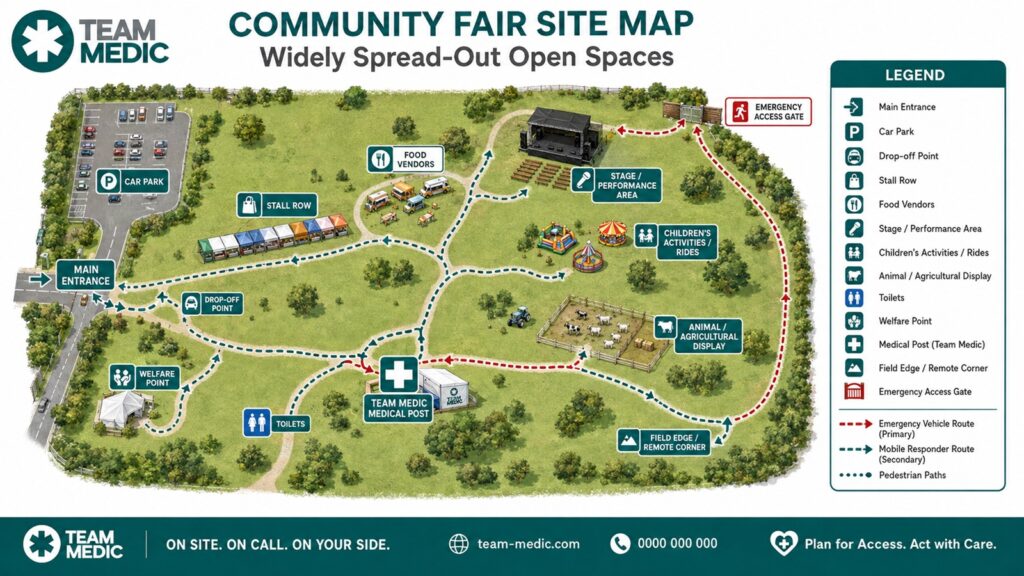
Widely spread-out open spaces
A fair may cover a park, village green, school field or several adjoining areas. Attractions and stalls can be spread far apart, increasing the time required to reach an incident.
Map:
Main event areas.
Car parks and drop-off points.
Stall and food-vendor rows.
Stages and performance spaces.
Children’s activities and rides.
Animal or agricultural displays.
Toilets and welfare facilities.
Field edges, paths and remote corners.
Depending on the layout, you may need a central medical post supported by mobile responders. The decision should be based on distance, access and activity risk-not attendance alone.
Temporary structures and weather
Marquees, gazebos, stages, fencing and temporary flooring can become more hazardous in wind and rain. Cables, wet entrances and unstable ground can create additional risks.
Check that:
Temporary structures are correctly installed and secured.
Emergency exits remain clear.
Cables and trip hazards are protected.
Flooring remains stable when wet.
Stalls do not obstruct emergency routes.
Vehicles are kept away from pedestrian areas.
Medical teams can reach the site without moving barriers or equipment.
First-response routes should be physically checked before opening and monitored throughout the event.
Accessible pathways for first responders
Grass can become soft, gravel can be difficult for mobility aids and temporary ramps may become slippery. Accessible routes should also accommodate medical equipment and response vehicles where appropriate.
Prioritise firm routes between:
Entrances and parking.
Medical and welfare facilities.
Toilets.
Main attractions.
Seating and sheltered areas.
Emergency access points.
If a route becomes unusable, have an alternative route ready rather than waiting for someone to report the problem.
What should your medical plan include?
A practical autumn event medical plan should be written down, shared with relevant teams and tested against realistic scenarios.
Before confirming your provision, establish:
The most likely medical incidents.
The most serious credible incidents.
Locations and times of highest risk.
Who can request medical assistance.
How responders identify a casualty’s location.
Whether every part of the site is accessible in poor weather.
Where patients will be assessed and kept warm.
How an ambulance will enter, rendezvous and leave.
What happens if the event is delayed or extended.
How medical, security, welfare and event-control teams communicate.
What happens during evacuation or a major incident.
Share the final site plan, timetable, risk assessment, traffic plan and emergency procedures with your provider before event day. Communicate any changes to the layout, programme or attendance expectations.
How to choose a medical provider
Choose a provider that assesses your event rather than offering a standard package without reviewing the details. The provider should ask about your site, audience, activities, timings, weather risks, access routes and existing safety arrangements.
Consider:
Experience with festivals, sporting events or community events.
Appropriate clinical skills and equipment.
Clear communications and escalation procedures.
Suitable treatment and welfare facilities.
Ability to provide mobile or static coverage.
Experience working on difficult outdoor terrain.
Integration with event control and security.
Clear documentation and pre-event planning.
Appropriate governance, registration and insurance.
Team Medic provides event medical services for a range of event environments, including festivals, sporting events and community events. Organisers can also explore Team Medic’s event first-aid provision.
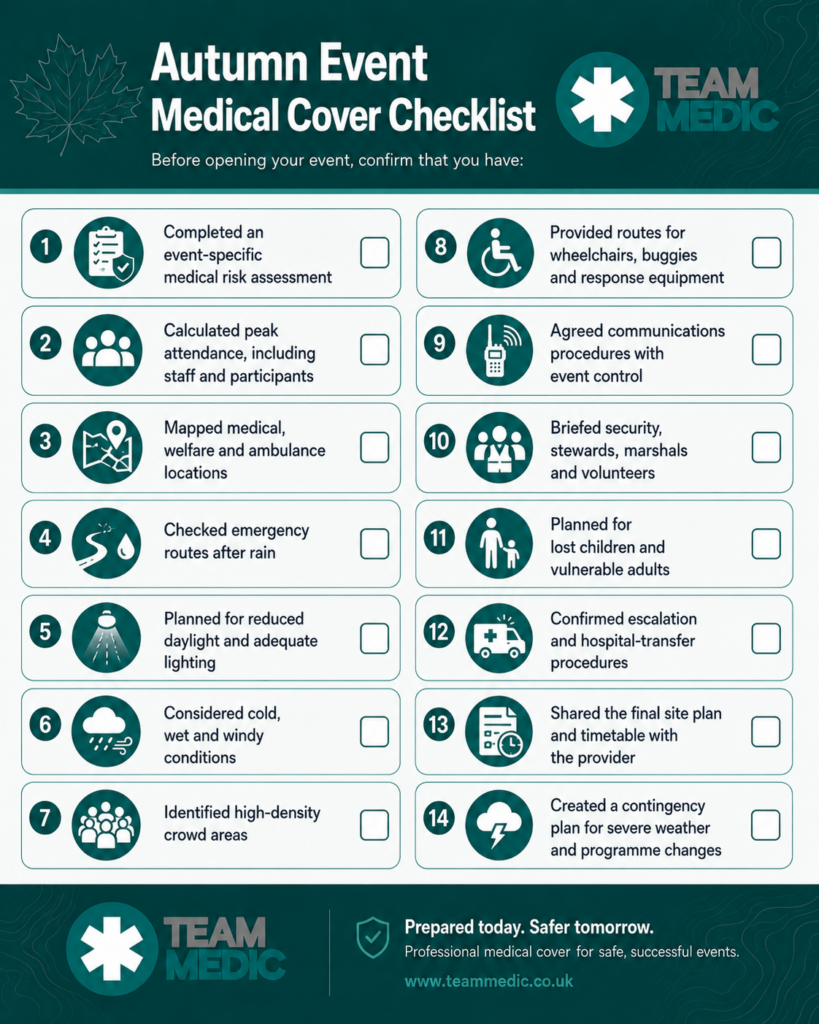
Completed an event-specific medical risk assessment.
Calculated peak attendance, including staff and participants.
Mapped medical, welfare and ambulance locations.
Checked emergency routes after rain.
Planned for reduced daylight and adequate lighting.
Considered cold, wet and windy conditions.
Identified high-density crowd areas.
Provided routes for wheelchairs, buggies and response equipment.
Agreed communications procedures with event control.
Briefed security, stewards, marshals and volunteers.
Planned for lost children and vulnerable adults.
Confirmed escalation and hospital-transfer procedures.
Shared the final site plan and timetable with the provider.
Created a contingency plan for severe weather and programme changes.
Frequently asked questions
What is autumn event medical cover?
Autumn event medical cover is the planned provision of medical personnel, equipment, treatment facilities and emergency procedures for an event held during autumn.
Does every autumn event need medical cover?
Every event should assess its first-aid and medical requirements. The appropriate provision depends on attendance, activities, venue conditions, weather, accessibility and emergency access.
Does bad weather affect medical planning?
Yes. Rain, mud, wind, cold and reduced daylight can increase injury risks and make it harder for responders to reach casualties. Organisers should check routes, shelter, lighting and vehicle access.
Do music festivals need different medical provision?
Music festivals may require planning for dense crowds, evening temperatures, muddy terrain, alcohol, substance-related risks, camping and multiple stages.
What medical cover does a sporting event need?
Sporting events may need medical teams positioned near the activity to respond to acute trauma. Separate arrangements may also be needed for spectators, officials and volunteers.
How can community fairs improve medical access?
Community fairs should provide clear, firm and accessible routes between key areas, especially when the site includes open fields, temporary structures, children’s activities and visitors of different ages.
When should organisers arrange medical cover?
Begin discussions while the site plan, activities, timings and risk assessment are being developed. Early planning allows medical access, treatment locations and response routes to be incorporated properly.