
Published by Team Medic (London) Ltd
Last clinically reviewed: November 2026
Guidance basis: Resuscitation Council UK Guidelines 2025
CPR on women uses the same core life-saving technique as CPR on men – but bras, breast tissue, AED pad placement, pregnancy and privacy can create practical complications that many rescuers have never been taught to handle.
But there is a moment that many first-aid demonstrations barely discuss. What happens when you need to expose her chest?
What happens when you need to expose her chest?
Do you remove her bra? What if it is underwired? Where exactly do the defibrillator pads go around breast tissue? Can you perform chest compressions without exposing her breasts? What about dignity, privacy, pregnancy or simply the fear that touching a woman’s chest could be misunderstood?
Those questions may sound secondary when somebody’s heart has stopped.
The uncomfortable reality is that they can cause hesitation.
And in cardiac arrest, hesitation costs time.
Quick answer: how is CPR performed on a woman?
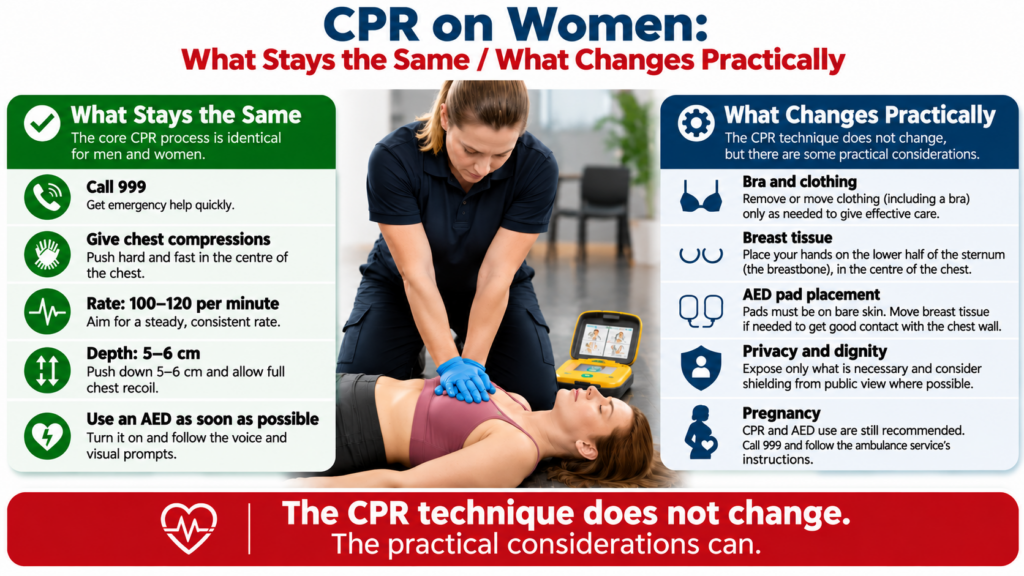
CPR is performed using the same fundamental technique regardless of sex.
For an adult in cardiac arrest:
Call 999, start chest compressions on the lower half of the sternum in the centre of the chest, and use an AED as soon as one is available.
For the complete adult resuscitation sequence, see our step-by-step guide to how to do CPR on an adult.
Breasts do not change where chest compressions are given.
A bra does not automatically have to be removed.
For defibrillation, however, AED pads must make direct contact with bare skin in the correct position. Current Resuscitation Council UK guidance says a bra can remain in place if correct pad positioning can be achieved around it. If the bra prevents correct placement, it should be moved or removed.
The priority is always effective CPR and timely defibrillation.
Privacy and dignity still matter – but they must not delay life-saving treatment.
Are women less likely to receive CPR?
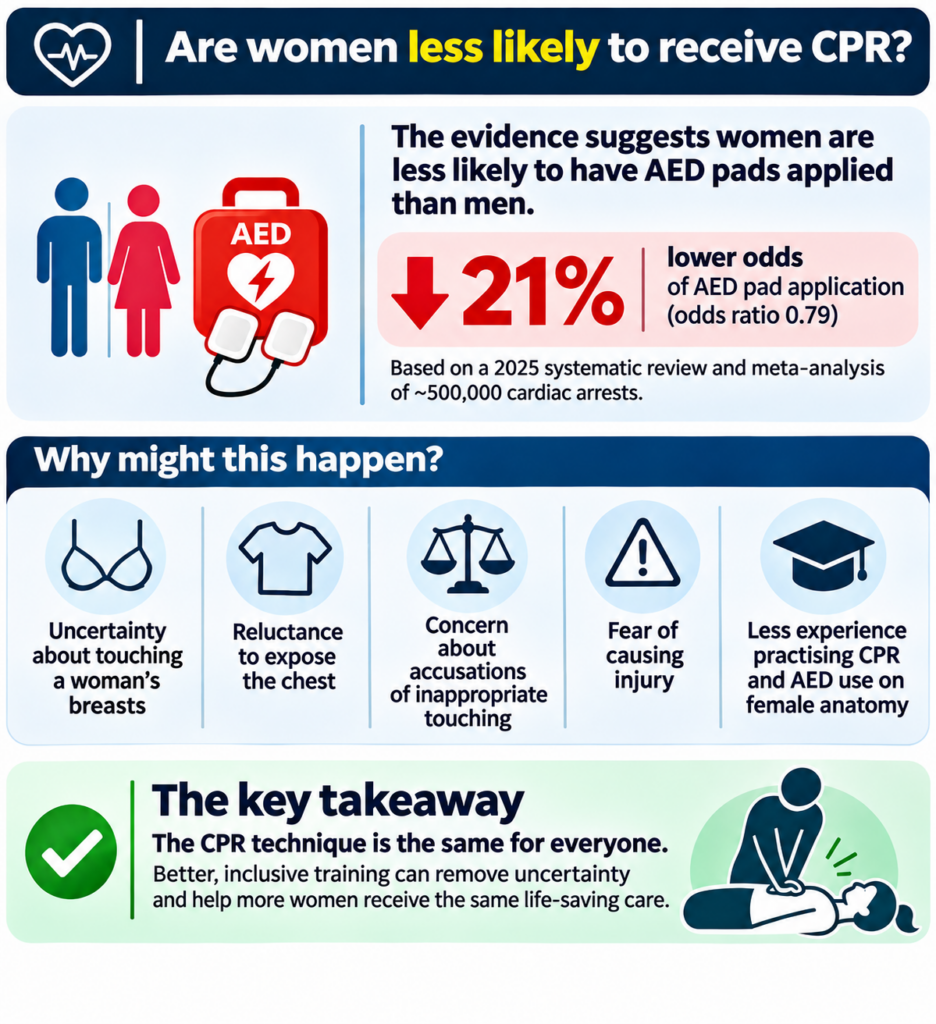
This is one reason the subject deserves more attention.
Research internationally has repeatedly identified differences in the likelihood of women receiving bystander CPR or public-access defibrillation, although the size and direction of the disparity vary between studies and settings.
A 2025 systematic review and meta-analysis involving almost half a million cardiac arrests found that women had lower odds of having AED pads applied than men. Evidence around the initiation of bystander CPR itself was more heterogeneous.
A separate global scoping review found that, among studies examining sex differences in bystander CPR, a majority reported women being less likely to receive it, although other studies found no difference or even higher rates in some circumstances.
Why might this happen?
Research into public attitudes has identified several possible barriers:
- uncertainty about touching a woman’s breasts;
- reluctance to expose her chest;
- concern about accusations of inappropriate touching;
- fear of causing physical injury; and
- lack of experience practising CPR and AED use on female anatomy.
The important point is not that every rescuer will hesitate.
It is that female anatomy can introduce uncertainty which ordinary CPR training has historically not always prepared people for.
That uncertainty can be removed.
Is CPR on women different from CPR on men?
The essential CPR technique is the same.
Current Resuscitation Council UK Adult Basic Life Support guidance recommends placing the heel of one hand on the lower half of the sternum – in the centre of the chest.
Place your second hand on top, keep your arms straight and deliver compressions:
100–120 times per minute
to a depth of:
at least 5cm but no more than 6cm
while allowing the chest to recoil fully between compressions.
Breast tissue does not change this anatomical landmark.
The sternum is still the sternum.
The heart still needs circulation.
And chest compressions should not be delayed because the casualty has breasts.
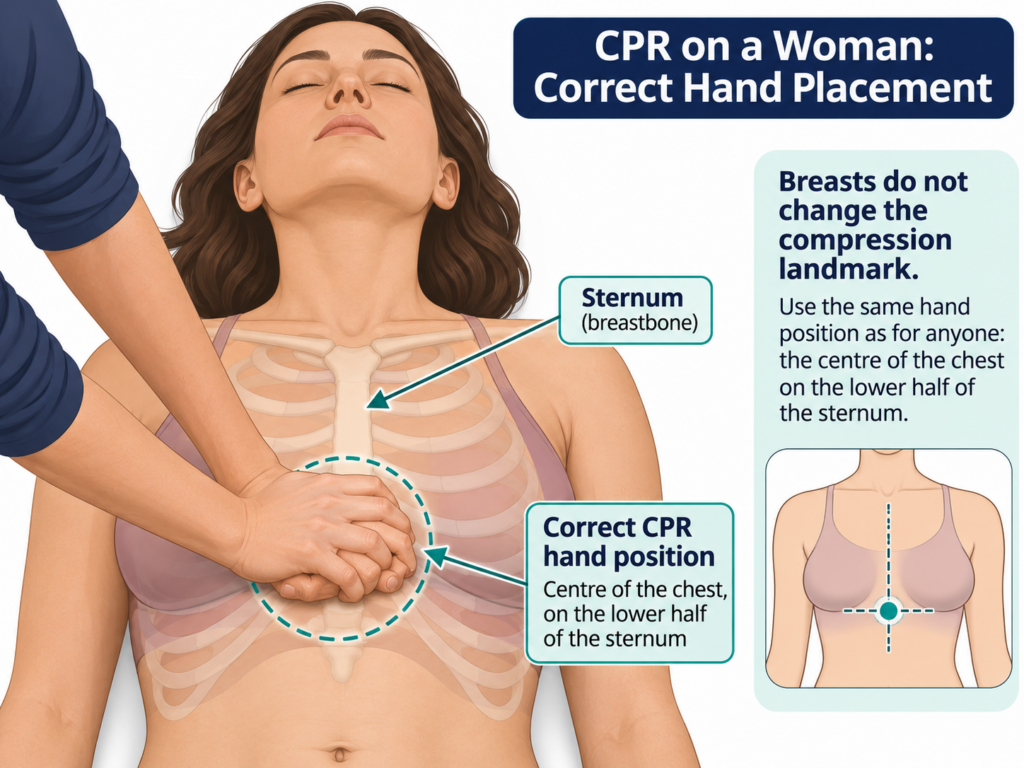
Where do your hands go during CPR on women?
This is probably the question people are most reluctant to ask.
Your hands go on the sternum in the centre of the chest, not on the breasts.
Breasts normally fall to either side of the central chest when somebody is lying flat, although anatomy varies considerably between individuals.
Find the centre of the chest and position the heel of your hand on the lower half of the sternum.
If clothing makes it difficult to identify the correct anatomical position, current RCUK guidance says it is reasonable to displace or remove clothing sufficiently to identify the sternum.
You do not need to expose more of the person’s body than is necessary simply to perform compressions.
The objective is accurate hand placement – not complete chest exposure.
Do you remove a bra during CPR on women?
Not routinely.
This is an important distinction between chest compressions and using an AED.
If you can identify the correct compression position, a bra does not normally need to be removed simply to perform chest compressions.
Start CPR.
Do not spend valuable time undressing somebody unnecessarily.
The situation changes when an AED arrives because the electrode pads must be attached directly to bare skin.
And this is where older teaching and common assumptions can create confusion.
Do you need to remove a bra before using an AED?
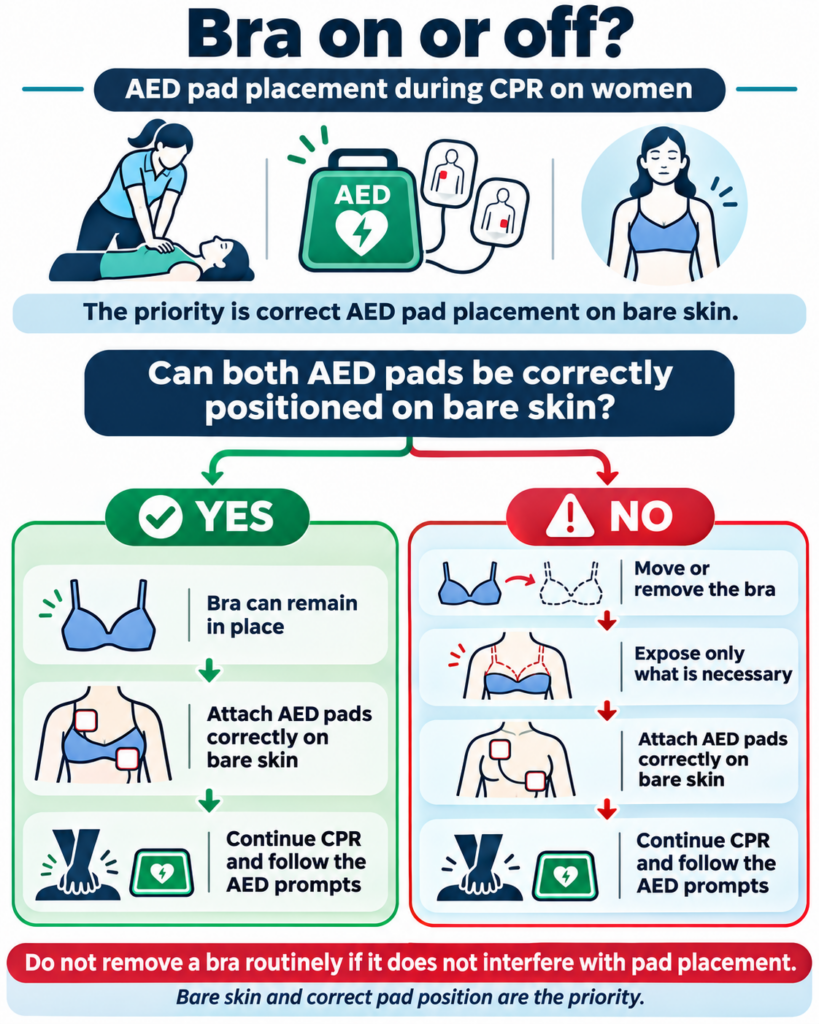
Not necessarily.
The Resuscitation Council UK 2025 Adult Basic Life Support Guidelines specifically address this question.
The priority is:
correct pad placement + direct contact with bare skin.
If those two requirements can be achieved quickly while leaving the bra in position, it is acceptable for the bra to remain.
If the bra prevents you from locating the correct pad position or prevents a pad making full contact with the skin, then it should be moved or removed.
This reflects the international evidence review carried out by the International Liaison Committee on Resuscitation.
ILCOR concluded that there is currently insufficient evidence to justify routine removal of every bra before defibrillation.
That is a significant point.
The question is not:
“Is she wearing a bra?”
The question is:
“Can I place both AED pads correctly on bare skin without delay?”
If yes, continue.
If no, move or remove whatever is obstructing you.
What about an underwired bra?
This is another area surrounded by assumptions.
Some older training approaches encouraged rescuers to remove bras because they might contain metal underwiring or clips.
Current international guidance is more nuanced.
The ILCOR evidence review found insufficient evidence to support routine bra removal and noted that spending time determining whether a bra contains metal could itself delay defibrillation.
So do not waste critical seconds inspecting underwear to work out what it is made from.
Instead, concentrate on what matters clinically:
Are the pads on bare skin?
Are they positioned correctly?
Is anything preventing full pad contact?
If the bra interferes with either pad, move or remove it.
If it does not interfere, do not delay the shock simply because the casualty is wearing one.
Where do AED pads go on a woman?
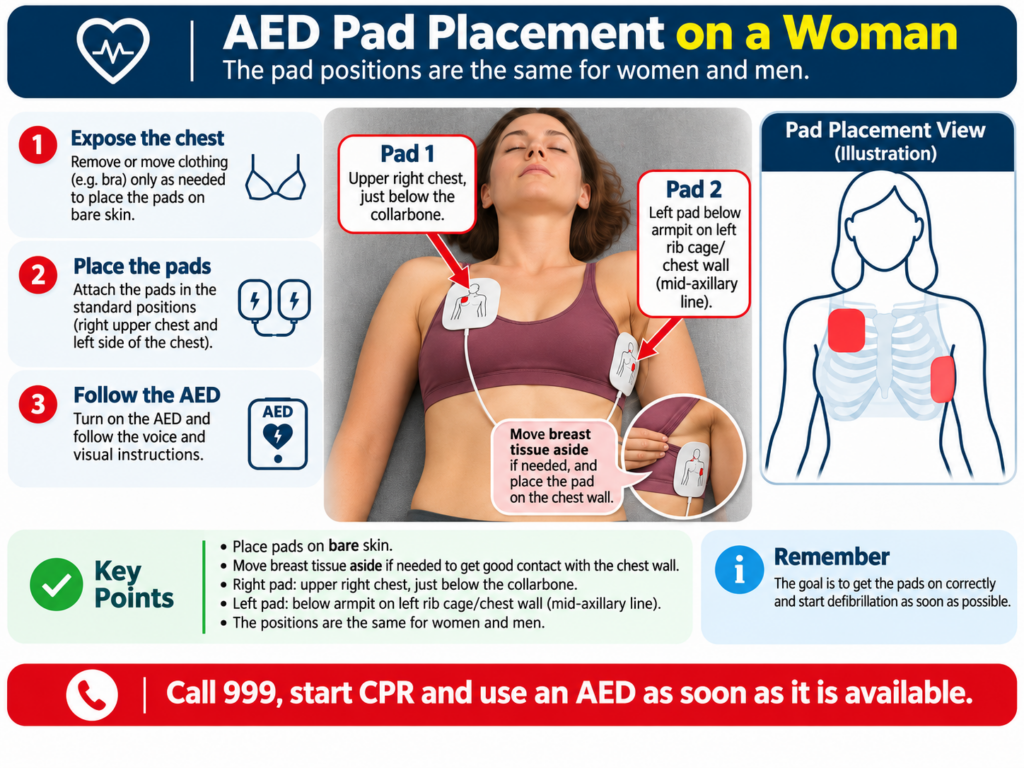
AED pad position is based on the chest wall – not on breast tissue.
For the usual antero-lateral position, one pad is placed on the upper right side of the chest, below the collarbone.
The other is placed on the left side of the chest, directly below the armpit around the mid-axillary line.
Always follow the diagram printed on the AED pads and the device’s spoken instructions.
With larger breasts, you may need to move breast tissue sufficiently to achieve proper pad contact with the chest wall.
The pad should not simply be stuck on top of a breast if that results in poor anatomical positioning or incomplete contact.
Correct pad placement matters because the electrical current needs to travel effectively through the chest.
If another rescuer is present, chest compressions should continue while the AED is being switched on and the pads are attached.
Do not stop CPR simply to preserve modesty.
Do you need to expose a woman’s breasts completely?
Usually, no more than is necessary for treatment.
For chest compressions alone, full exposure is generally unnecessary if you can identify the sternum accurately.
For AED use, enough of the chest must be accessible to position both pads directly against bare skin.
That may mean:
- lifting or moving clothing;
- moving bra fabric;
- moving breast tissue sufficiently for correct pad placement; or
- removing the bra if it prevents correct placement.
Once the pads are attached and CPR is continuing, privacy can be protected where practical without obstructing treatment.
For example, if several people are present, one person can help shield the casualty from unnecessary view using a coat, blanket or by positioning themselves appropriately.
Unnecessary bystanders can be asked to step away.
But none of this should interrupt compressions or delay defibrillation.
Preserve dignity where you can. Preserve life first.
What if you are worried about touching a woman’s breasts?
This concern is more common than many training courses acknowledge.
Research into public perceptions of CPR has identified concern about inappropriate touching and fear of being accused of sexual assault as potential barriers to helping women in cardiac arrest.
The practical answer is straightforward.
If someone is unresponsive and not breathing normally, they may be in cardiac arrest.
They may die without immediate intervention.
Your actions should be purposeful and directly related to the life-saving treatment you are providing.
Place your hands where CPR requires.
Move clothing or breast tissue only where necessary to locate the sternum or apply AED pads correctly.
Do not touch the casualty unnecessarily.
But equally:
do not withhold CPR because you are frightened of touching someone’s chest.
The Resuscitation Council UK’s guidance is explicit that rescuers should not be concerned about exposing the person’s chest where necessary to apply AED pads and should prioritise life-saving interventions.
Privacy and dignity during CPR on women
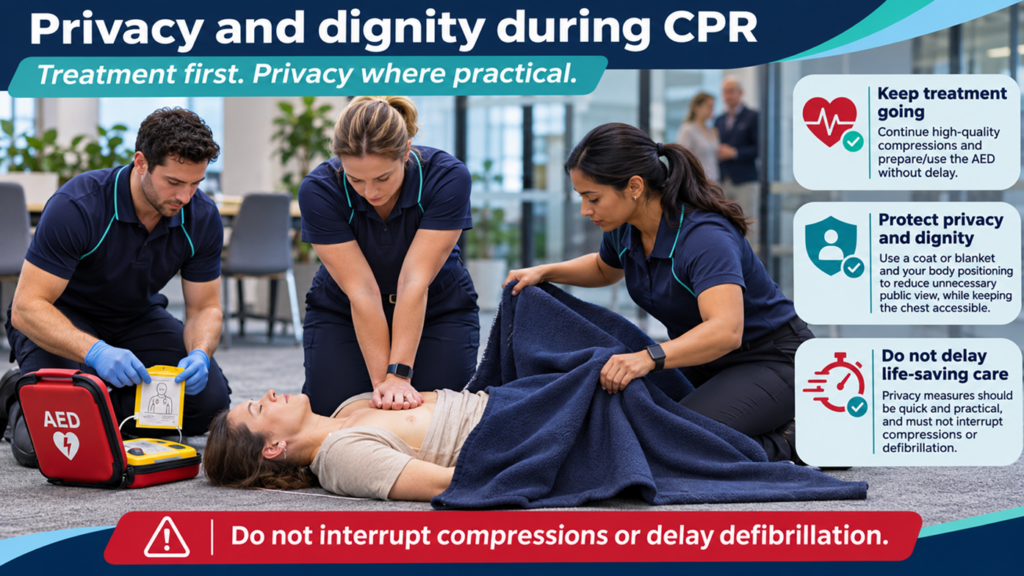
Privacy and dignity do not suddenly stop mattering because somebody is unconscious.
But in cardiac arrest, they have to be balanced against the urgent need to save life.
A good principle is:
Expose what you need. Treat what you find. Protect everything else where reasonably possible.
If there are several rescuers, roles can be divided.
One person can maintain compressions.
Another can prepare and attach the AED pads.
A third can manage the emergency call, retrieve equipment or help screen the casualty from unnecessary view.
If only one rescuer is present, those considerations become secondary to calling 999, starting CPR and using an AED.
The ambulance service call handler can guide you throughout.
What about consent if the woman is unconscious?
An unconscious person in cardiac arrest cannot give express consent to treatment.
In an emergency such as cardiac arrest, implied consent is generally relied upon: it is reasonable to assume that, if the person were conscious and able to make a decision, they would consent to immediate treatment intended to save their life.
This means a bystander should not delay CPR or AED use while worrying about obtaining consent. Emergency treatment should be necessary, proportionate and focused on the person’s best interests.
For a bystander, the practical priority is simple:
Call 999, start CPR if the person is not breathing normally, and follow the ambulance service call handler’s instructions.
Concerns about embarrassment, clothing, physical contact or consent should not prevent appropriate life-saving care for an unconscious person in suspected cardiac arrest.
CPR on women during pregnancy
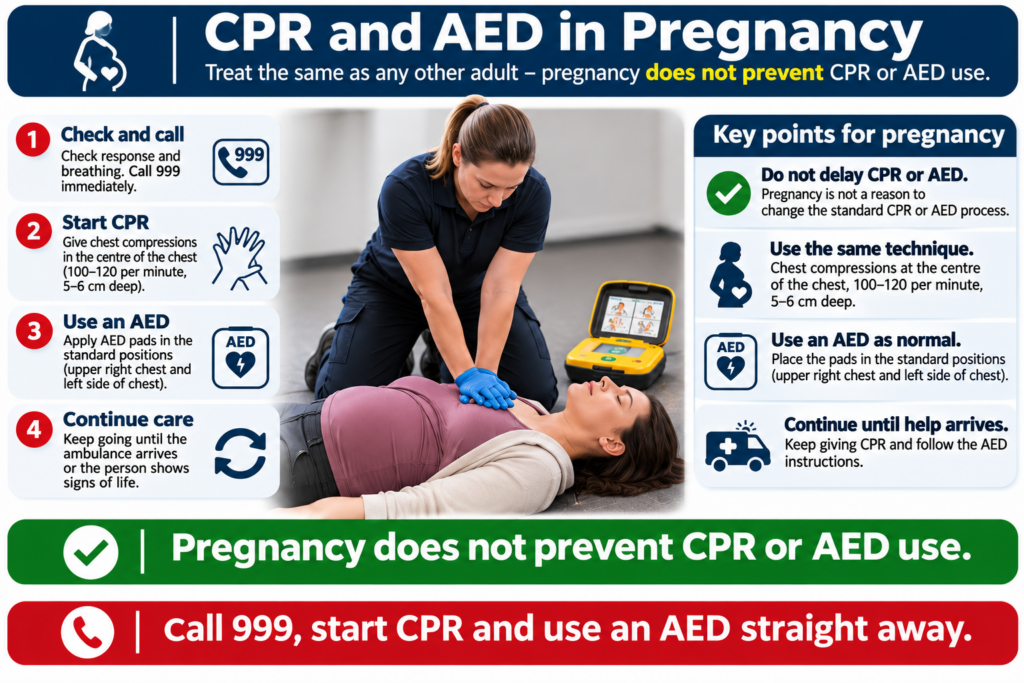
Pregnancy does not mean you should withhold CPR or an AED.
The Resuscitation Council UK states that an AED can be used on a pregnant woman.
For the public and most first aiders, the immediate priorities remain:
Call 999.
Start CPR.
Use an AED.
Make sure the AED pads are positioned correctly and clear of enlarged breast tissue.
For healthcare professionals and appropriately trained responders, maternal cardiac arrest has additional clinical considerations.
RCUK’s 2025 Special Circumstances Guidelines advise that, above approximately 20 weeks of pregnancy, aortocaval compression should be relieved during resuscitation, with manual left uterine displacement preferred while effective chest compressions continue.
That is an advanced resuscitation consideration.
A member of the public should not delay standard CPR trying to perform specialist obstetric manoeuvres.
Tell the 999 call handler that the casualty is pregnant and follow their instructions.
What if the woman has very large breasts?
The principles remain unchanged.
Chest compression hand position is still based on the sternum.
AED pad placement is still based on the chest wall.
Larger breasts may make the lateral AED pad more awkward to position, but the solution is not to put the pad wherever it is easiest.
Move breast tissue sufficiently to achieve the position shown on the AED diagram, ensuring the adhesive pad has proper contact with bare skin.
If clothing or a bra interferes, move it.
If it must be removed, remove it.
Do not compromise pad position simply to avoid handling breast tissue.
What if there is a pacemaker or implanted defibrillator?
Some people have an implanted pacemaker or cardioverter-defibrillator visible as a raised area beneath the skin, usually in the upper chest.
This should not stop you using an AED.
Professional RCUK guidance advises positioning a defibrillator pad more than 8 cm away from an implanted device or using an alternative appropriate pad position.
Follow the AED’s instructions and the guidance of the ambulance call handler.
Do not delay chest compressions.
Does CPR training prepare people properly for female anatomy?
Historically, CPR training has overwhelmingly used flat-chested, male-presenting manikins.
That matters more than it might first appear.
Recent simulation research has found that rescuers can hesitate or perform differently when confronted with realistic female anatomy.
One study using female anatomical manikins identified delays and poorer initial performance in areas including hand placement and AED use. Retraining improved performance.
Other recent studies have found that practising with female-appearing CPR manikins can improve confidence, reduce discomfort about clothing removal and improve AED pad placement.
This supports a broader lesson:
CPR training should prepare people for real people.
Real casualties come in different sizes, shapes and body types.
Some have breasts.
Some are pregnant.
Some wear bras, sports bras, shapewear or several layers of clothing.
Some have scars, implanted devices or mobility limitations.
A training scenario that never confronts those realities can leave a learner technically qualified but psychologically unprepared.
And cardiac arrest is the worst possible time to encounter that uncertainty for the first time.
Why hesitation matters
There is a much bigger issue behind bras and breasts.
The whole purpose of CPR training is to help somebody act when circumstances are uncomfortable, stressful and unfamiliar.
Current RCUK guidance emphasises early recognition of cardiac arrest, an early 999 call, immediate chest compressions and rapid use of an AED.
The sequence should not change because the casualty is a woman.
If an unresponsive woman is not breathing normally:
assume cardiac arrest.
Start CPR.
Get an AED.
Everything else should support those actions rather than delay them.
Before CPR begins, recognising unresponsiveness and abnormal breathing forms part of the initial casualty assessment. Our Primary Survey First Aid guide explains the structured checks used to identify immediate threats to life.
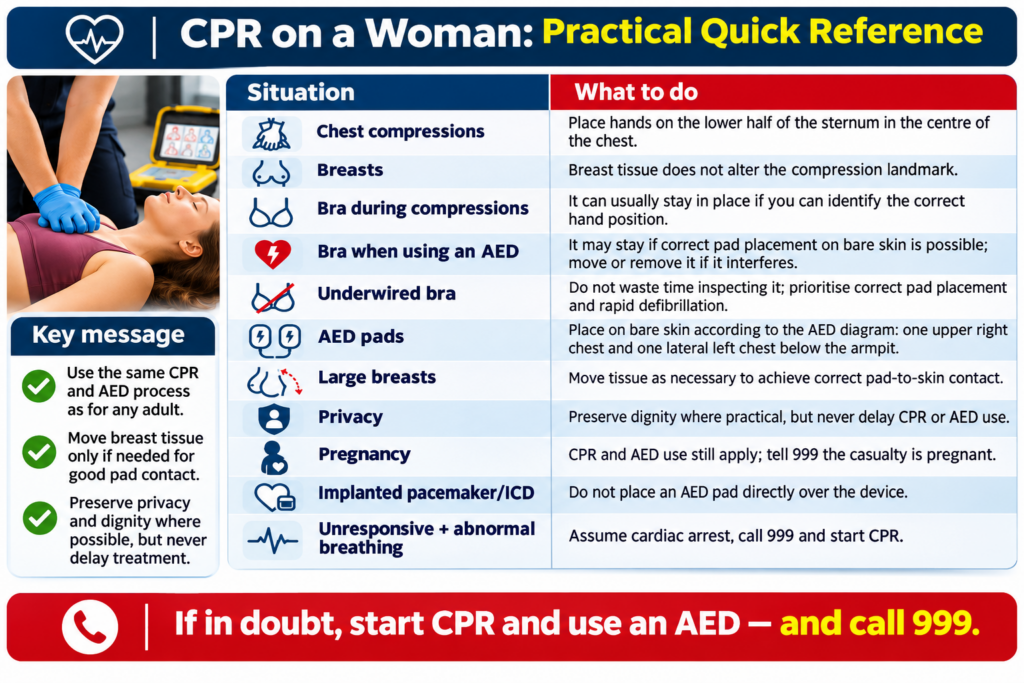
CPR on a woman: practical quick reference
Frequently asked questions
Usually not for chest compressions alone.
If you can identify the centre of the chest and place your hands correctly, start compressions without wasting time removing clothing.
For an AED, pads must make contact with bare skin. Move or remove the bra only if it prevents correct pad placement.
Your hands should be positioned on the lower half of the sternum in the centre of the chest, rather than on breast tissue.
Breasts do not change the correct compression point.
Not automatically.
Current RCUK and international guidance does not require routine bra removal. Correct AED pad placement on bare skin is the priority.
If the bra interferes with that, move or remove it.
Follow the AED diagram.
The lateral pad should normally sit on the left side of the chest directly below the armpit, with the pad making full contact with the chest wall.
Move breast tissue if necessary to achieve the correct position.
Yes.
RCUK states that an AED can be used during pregnancy. Standard CPR should continue and pads should be positioned clear of enlarged breast tissue.
No, not when exposure is required for effective life-saving treatment.
Preserve privacy and dignity as much as reasonably possible, but do not delay CPR or defibrillation.
Act purposefully and only as required to provide life-saving care.
If an unresponsive person is not breathing normally, immediate CPR and defibrillation may be their only chance of survival.
Call 999, follow the call handler’s instructions and do not allow fear of embarrassment to stop you acting.
CPR on women is not primarily a technical problem.
It is a confidence problem.
The compression rate does not change.
The compression depth does not change.
The need for early defibrillation does not change.
What changes is that a rescuer may suddenly find themselves confronting anatomy, clothing, privacy and social boundaries that their training never prepared them to deal with.
That is exactly why these questions should be discussed before an emergency happens.
If somebody’s heart stops, the worst outcome is not that you briefly expose their chest while trying to save them.
It is that nobody acts because everyone is too uncomfortable to start.
Reading about CPR is useful.
Practising it is better.
Effective first-aid training should prepare learners not only to remember compression rates and AED diagrams, but to make confident decisions in realistic situations.
Team Medic delivers practical first-aid and resuscitation training for workplaces, organisations and community settings.
If you want to understand the assessment that comes immediately before CPR, read our Primary Survey First Aid: Complete ABCDE Guide.
For the complete adult resuscitation sequence, see our How to Do CPR on an Adult: Step-by-Step UK Guide.
And if your organisation needs practical CPR, AED or workplace first-aid training, explore Team Medic First Aid Training.
Medical disclaimer
This article provides general first-aid education and does not replace accredited practical training or individual medical advice.
If somebody is unresponsive, call 999 immediately. If they are not breathing normally, assume cardiac arrest, start CPR and follow the ambulance service call handler’s instructions.
Clinical sources and further reading
Resuscitation Council UK – Adult Basic Life Support Guidelines 2025
Primary clinical source for adult CPR, chest-compression position, the early 999 call, AED use, bare-skin pad placement and current guidance on bras during defibrillation.
International Liaison Committee on Resuscitation – 2025 Adult Basic Life Support Consensus on Science with Treatment Recommendations
Source for the international evidence review concerning bra removal, women, AED pad application and the recommendation to prioritise correct pad placement over routine bra removal.
Resuscitation Council UK – Special Circumstances Guidelines 2025
Source for maternal cardiac arrest and resuscitation considerations during pregnancy.
Resuscitation Council UK – Guidance on Defibrillators
Source for AED use in pregnancy and positioning pads clear of enlarged breast tissue.
Systematic review and meta-analysis of sex and bystander CPR/AED use, 2025
Contemporary evidence examining sex differences in bystander CPR initiation and public AED application.
Global scoping review of sex disparities in bystander CPR
Evidence examining differences in receipt of CPR between women and men across international studies.
UK Government – Mental Capacity Act guidance for health and social care
Supporting source concerning urgent treatment and emergency procedures, including CPR, where a person lacks capacity.
Image note: All illustrations and infographics in this article are original editorial graphics created for Team Medic. Clinical statements and data shown within them are based on the primary guidelines and peer-reviewed research listed below.
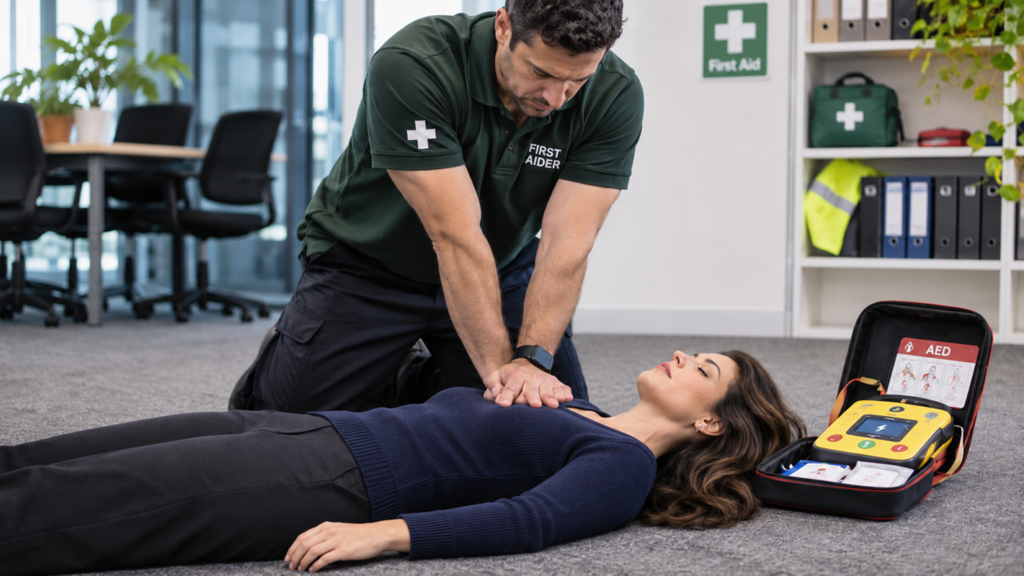
Featured image – responder performing CPR on an adult woman with an AED nearby
Clinical basis: Resuscitation Council UK, Adult Basic Life Support Guidelines 2025. Supports adult CPR, early chest compressions, compression rate/depth and early AED use.
“CPR on Women: What Stays the Same / What Changes Practically” infographic
Clinical basis: Resuscitation Council UK, Adult Basic Life Support Guidelines 2025 for CPR technique and AED use; RCUK Guidance: Defibrillators for AED use in pregnancy; ILCOR – Removal of bra for pad placement and/or defibrillation: Scoping Review for bra-related considerations; and RCUK Special Circumstances Guidelines 2025 for maternal cardiac arrest. ILCOR CoSTR
Correct CPR hand placement on a woman
Clinical basis: Resuscitation Council UK, Adult Basic Life Support Guidelines 2025. Supports placing the heel of the hand on the lower half of the sternum in the centre of the chest, with compressions at 100–120/min and 5–6 cm depth.
“Bra on or off?” AED decision infographic
Clinical basis: Resuscitation Council UK, Adult Basic Life Support Guidelines 2025 and ILCOR – Removal of bra for pad placement and/or defibrillation: Scoping Review. ILCOR found insufficient evidence to justify routine bra removal and emphasises that AED pads need full contact with the chest wall. ILCOR CoSTR
Correct female AED pad-placement illustration
Clinical basis: Resuscitation Council UK, Adult Advanced Life Support Guidelines 2025. The 2025 guidance places greater emphasis on correct initial pad position and states that the lateral/apical pad should be positioned below the armpit in the mid-axillary line.
Also supported by RCUK Adult Basic Life Support Guidelines 2025 for AED use by members of the public.
Privacy and dignity during CPR illustration
Clinical basis: Resuscitation Council UK, Adult Basic Life Support Guidelines 2025. The guidance prioritises life-saving treatment and rapid AED use. The use of a coat, blanket or another responder to reduce unnecessary exposure is Team Medic practical editorial guidance, provided it does not interrupt CPR or delay defibrillation.
CPR and AED use during pregnancy infographic
Clinical basis: Resuscitation Council UK, Special Circumstances Guidelines 2025 and RCUK Guidance: Defibrillators. Pregnancy does not prevent CPR or AED use; advanced maternal-resuscitation guidance includes measures to address aortocaval compression in later pregnancy. Resuscitation Council UK
“CPR on a Woman: Practical Quick Reference” infographic
Clinical basis: RCUK Adult Basic Life Support Guidelines 2025; RCUK Adult Advanced Life Support Guidelines 2025; RCUK Guidance: Defibrillators; RCUK Special Circumstances Guidelines 2025; and the ILCOR bra-removal scoping review. These collectively support CPR technique, AED use, pad position, pregnancy, implanted-device considerations and bra/clothing management. Resuscitation Council UK
“Are women less likely to receive CPR?” infographic
Primary evidence: Catalisano G, Ippolito M, Spina N, et al. Association between bystander cardiopulmonary resuscitation initiation and patient’s sex: a systematic review and meta-analysis. Resuscitation Plus. 2025;22:100916. DOI: 10.1016/j.resplu.2025.100916. The review included 15 observational studies and 499,854 cardiac arrests; women had lower odds of AED pad application than men, OR 0.79 (95% CI 0.66–0.94).
Supporting evidence: Chen C, Lo CYZ, Ho MJC, et al. Global Sex Disparities in Bystander Cardiopulmonary Resuscitation After Out-of-Hospital Cardiac Arrest: A Scoping Review. J Am Heart Assoc. 2024;13:e035794. Around 59% of the relevant studies found women less likely to receive bystander CPR or more likely to receive a lower-quality form of CPR; 36% found no clear sex difference and 5% found women more likely to receive CPR.
Supporting evidence for perceived barriers: Perman SM, Shelton SK, Knoepke C, et al. Public Perceptions on Why Women Receive Less Bystander Cardiopulmonary Resuscitation Than Men in Out-of-Hospital Cardiac Arrest. Circulation. 2019;139(8):1060–1068. DOI: 10.1161/CIRCULATIONAHA.118.037692. The study identified concerns around inappropriate touching, accusations of sexual assault, breast exposure and fear of injury.