Quick answer: A primary survey is a rapid, structured assessment used to identify and treat immediate threats to life. Current Resuscitation Council UK guidance recommends paying immediate attention to safety, responsiveness and life-threatening bleeding, then using ABCDE: Airway, Breathing, Circulation, Disability and Exposure to structure the assessment. If someone is unresponsive, call 999 immediately and assess their breathing while the call is being connected.
When someone suddenly collapses, is seriously injured or becomes acutely unwell, the first few actions matter.
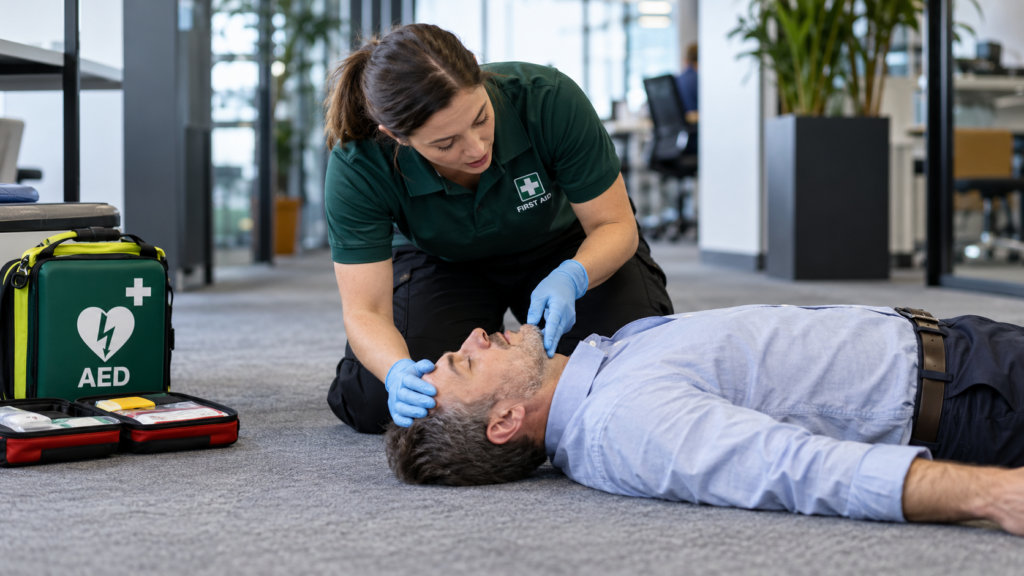
A dramatic injury can easily draw your attention. But what looks worst is not always what is most immediately dangerous. The purpose of the primary survey in first aid is to assess a casualty in a consistent order so that problems capable of causing death or rapid deterioration are identified and treated first.
The Resuscitation Council UK (RCUK) First Aid Guidelines 2025 recommend a structured ABCDE assessment. They also state that immediate attention should be given to scene safety, responsiveness and life-threatening bleeding before progressing through that framework.
There is also an important change in the 2025 Adult Basic Life Support Guidelines. If a person is unresponsive, RCUK now advises calling 999 as soon as possible, rather than waiting until you have established whether their breathing is normal.
That is important because it differs from the order many people remember from traditional DRABC first-aid training.
What is the primary survey in first aid?
A primary survey is a rapid assessment of an ill or injured person designed to identify and manage conditions that pose an immediate threat to life.
It is not intended to establish a complete diagnosis.
Instead, the first aider looks systematically for problems involving the casualty’s airway, breathing, circulation and neurological condition, while also identifying severe bleeding and other immediately dangerous conditions.
RCUK describes first aid as involving the recognition, assessment and prioritisation of a person’s needs, providing care within the first aider’s competence and seeking additional help when required. The 2025 guidance specifically recommends using ABCDE to promptly identify and treat life-threatening conditions.
Primary survey sequence at a glance
Before ABCDE:
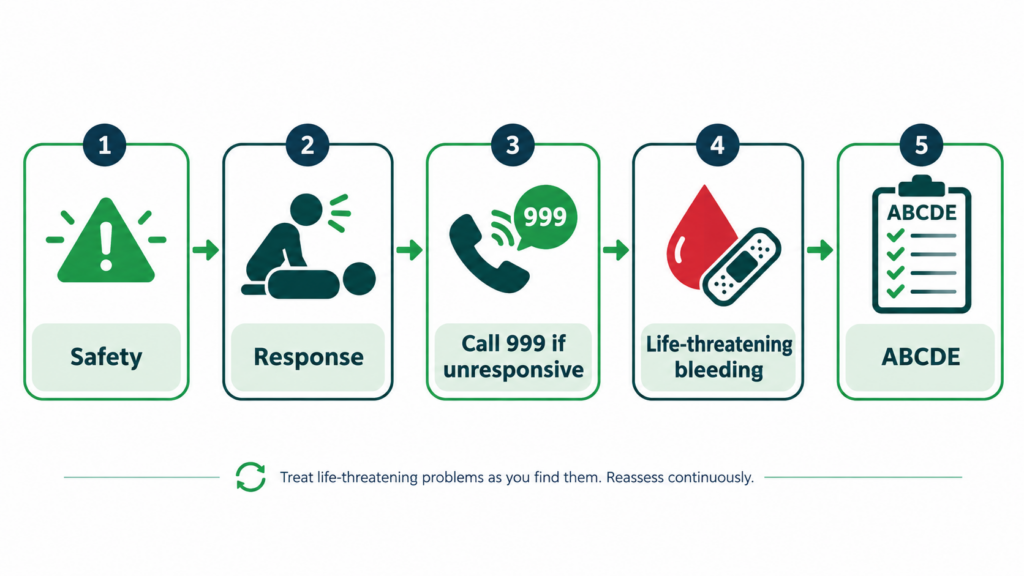
Then:
A – Airway
B – Breathing
C – Circulation
D – Disability
E – Exposure
The most important principle is not simply remembering five letters.
It is:
Identify a life-threatening problem → treat it → reassess → then continue.
DRABC, DRSABCDE and ABCDE: which is correct?
This is where there is considerable confusion online.
Traditional UK first-aid training commonly uses DRABC:
D – Danger
R – Response
A – Airway
B – Breathing
C – Circulation
You may also encounter DRSABC, DRSABCDE, DRCABCDE, CABCDE or similar variants in different training and clinical environments.
However, it would be inaccurate to say that RCUK formally replaced DRABC with a new universal acronym called DRSABCDE in 2025.
The actual RCUK First Aid Guidelines say:
- give immediate attention to safety;
- establish the person’s responsiveness;
- identify life-threatening bleeding; and
- use ABCDE to structure the assessment.
RCUK explicitly defines ABCDE as Airway, Breathing, Circulation, Disability and Exposure.
So, while an expanded mnemonic can be useful in training, ABCDE is the structured assessment framework specified in the current RCUK First Aid Guidelines.
What changed in the 2025 guidelines?
One particularly important change concerns the emergency call.
Under RCUK’s 2025 Adult Basic Life Support guidance:
If a person is unresponsive, call 999 as soon as possible.
You no longer have to establish abnormal breathing before initiating the emergency call. Where possible, use your phone’s loudspeaker and assess breathing while waiting for the ambulance service to answer.
This allows an ambulance service call handler to assist with recognising cardiac arrest and guide the rescuer through CPR where necessary.
How to perform a primary survey step by step
1. Check for danger and scene safety
Before approaching the casualty, make sure doing so will not put you, the casualty or other people in additional danger.
Potential hazards might include traffic, electricity, fire, smoke, hazardous substances, unstable structures, water or violent behaviour.
RCUK lists checking scene safety as one of the fundamental principles expected of a first-aid provider.
Do not enter an unsafe situation simply because somebody needs help. Where necessary, contact the emergency services and wait until the hazard can be controlled.
2. Check whether the casualty responds
Approach the casualty and establish whether they are responsive.
Speak clearly to them and look for an appropriate response, such as opening their eyes, answering you or making purposeful movements.
For example:
“Hello. Can you hear me? Are you all right?”
If the person does not respond, treat this seriously.
If they are unresponsive: call 999 now
This is one of the most important updates to understand from the 2025 guidance.
RCUK now advises that an unresponsive person should trigger an immediate 999 call, before you have determined whether their breathing is normal.
If somebody else is present, direct them to make the call.
If you are alone and have a mobile phone, activate the speaker function, call 999 and continue assessing the casualty while the call is connecting.
The ambulance service call handler can then help you decide whether the casualty’s breathing is abnormal and provide CPR instructions if needed.
3. Look immediately for life-threatening bleeding
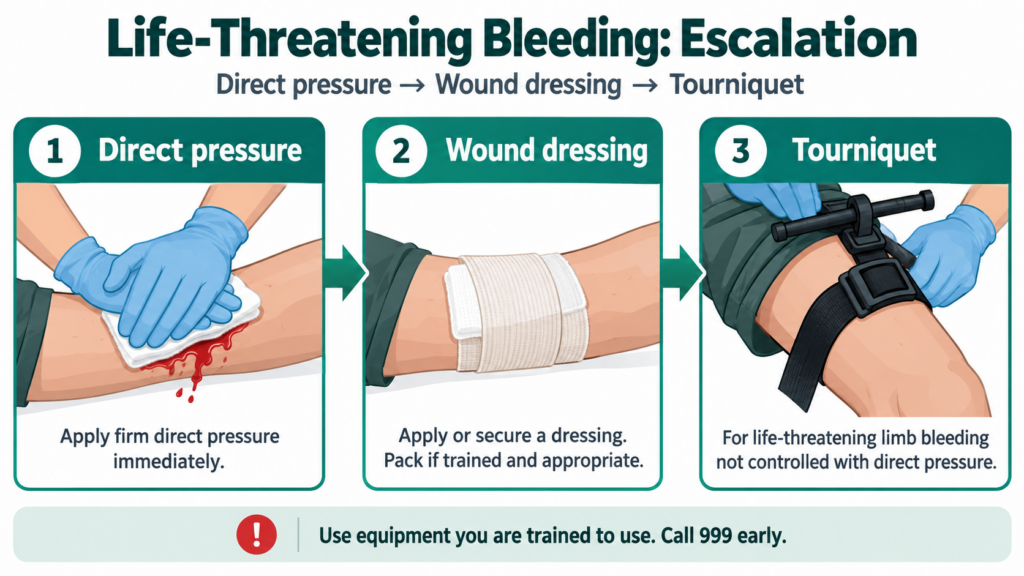
Severe blood loss requires immediate attention.
Do not ignore obvious, life-threatening bleeding while methodically working your way towards “C” in ABCDE. RCUK specifically instructs first aiders to pay immediate attention to life-threatening bleeding before using ABCDE to structure the rest of the assessment.
Examples could include rapid, continuous or substantial external bleeding.
What should you do?
RCUK recommends an escalating approach.
Start with firm, direct manual pressure over the bleeding site.
A standard dressing – or ideally a haemostatic dressing where available and appropriate – may then be applied with firm pressure. Some wounds may require the dressing to be packed into the wound.
For life-threatening bleeding from an arm or leg that is not controlled by direct manual pressure, current RCUK guidance recommends applying a tourniquet as soon as possible.
First-aid equipment should normally be used within the person’s level of training, unless emergency services instruct otherwise.
A – Airway
Ask:
Is the casualty’s airway open and clear?
A person who can speak normally has an open airway at that moment. In an unresponsive casualty, however, the muscles supporting the airway may relax and the airway can become obstructed.
Open the airway using an appropriate airway-opening technique where required.
If you can clearly see an object obstructing the mouth and it can be safely removed, remove it. Do not perform a blind finger sweep inside the casualty’s mouth; RCUK specifically advises against blind finger sweeps for foreign-body airway obstruction.
What if a spinal injury is suspected?
Unnecessary neck movement should be minimised where cervical spinal injury is suspected.
However, maintaining an airway takes priority.
RCUK states that airway opening, where necessary, has priority over maintaining spinal immobilisation.
B – Breathing
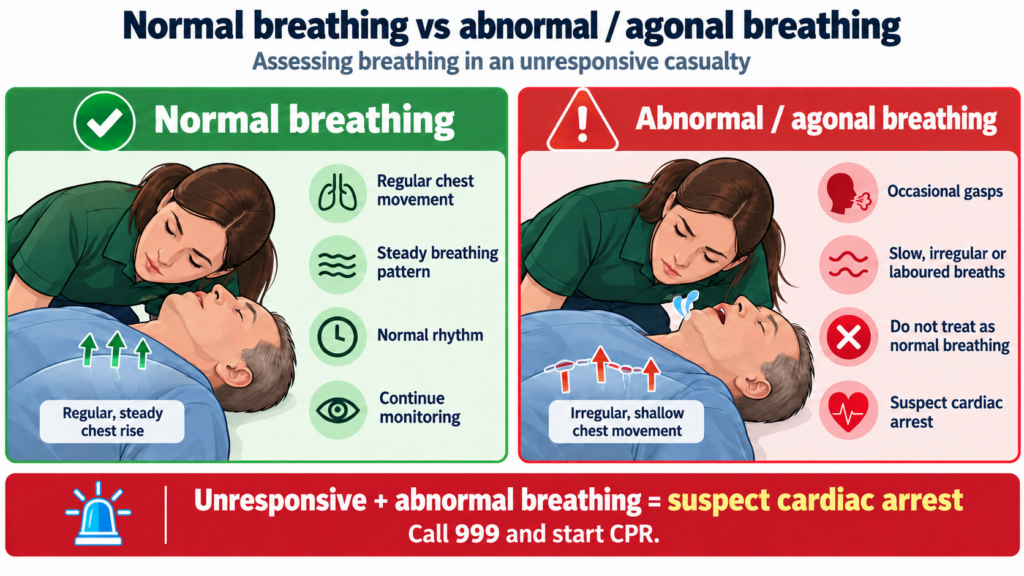
Once you have considered the airway, assess whether the casualty is breathing normally.
This is particularly important in an unresponsive casualty.
Abnormal breathing can sometimes be mistaken for normal breathing after cardiac arrest.
RCUK specifically warns that:
- slow or laboured breathing;
- agonal gasping; and
- panting
may indicate cardiac arrest in an unresponsive person.
Unresponsive and not breathing normally?
Assume cardiac arrest.
Start CPR immediately and follow the instructions given by the ambulance service call handler.
An AED should be retrieved and used as soon as one becomes available.
RCUK states that anyone can use an Automated External Defibrillator (AED). You do not need previous AED training: switch the device on and follow its spoken or visual instructions.
Unresponsive but breathing normally?
They do not currently meet the criteria for CPR, but they still require urgent assessment and continued monitoring.
RCUK recommends placing a person with a reduced level of responsiveness who does not require CPR into a lateral recovery position, except in situations such as trauma or agonal breathing where moving them into the recovery position would be inappropriate.
Continue to monitor their breathing.
If it becomes abnormal or stops, reassess and begin CPR as appropriate.
C – Circulation
Now consider the casualty’s circulation and look for other evidence of significant bleeding or circulatory compromise.
Remember that obvious life-threatening external bleeding should already have been addressed rather than waiting until the “C” stage.
Look at the casualty’s overall condition.
Signs such as marked pallor, clammy skin, weakness, altered responsiveness or rapid deterioration may indicate a serious problem requiring urgent medical help.
For a member of the public assessing an unresponsive casualty, do not delay CPR while trying to find a pulse if the casualty is not breathing normally.
Current RCUK community BLS guidance uses responsiveness and breathing to identify suspected cardiac arrest, with support from the ambulance service call handler.
D – Disability
“Disability” refers to a rapid assessment of the casualty’s neurological state.
Consider questions such as:
- Are they alert?
- Have they become confused?
- Are they unusually drowsy?
- Have they had a seizure?
- Are there signs of a stroke?
- Have they sustained a significant head injury?
- Is their level of consciousness changing?
If stroke is suspected, RCUK recommends using a recognised stroke assessment such as FAST – Face, Arm, Speech, Time – and calling 999.
A deteriorating level of consciousness should trigger another assessment from the beginning because changes in consciousness may also threaten the casualty’s airway.
E – Exposure
The final stage is Exposure.
This means looking for important injuries or signs of illness that may not initially have been obvious.
Depending on the circumstances, these might include:
- bleeding;
- wounds;
- burns;
- swelling
- deformity
- rashes; or
- other evidence of injury or illness.
Only expose as much of the person as is reasonably necessary.
Maintain their privacy and dignity, and remember that exposing somebody unnecessarily can contribute to heat loss, particularly outdoors or in cold conditions.
The objective is to avoid missing an important injury while continuing to protect the casualty.
The primary survey is not a one-off check
One of the most important principles of patient assessment is reassessment.
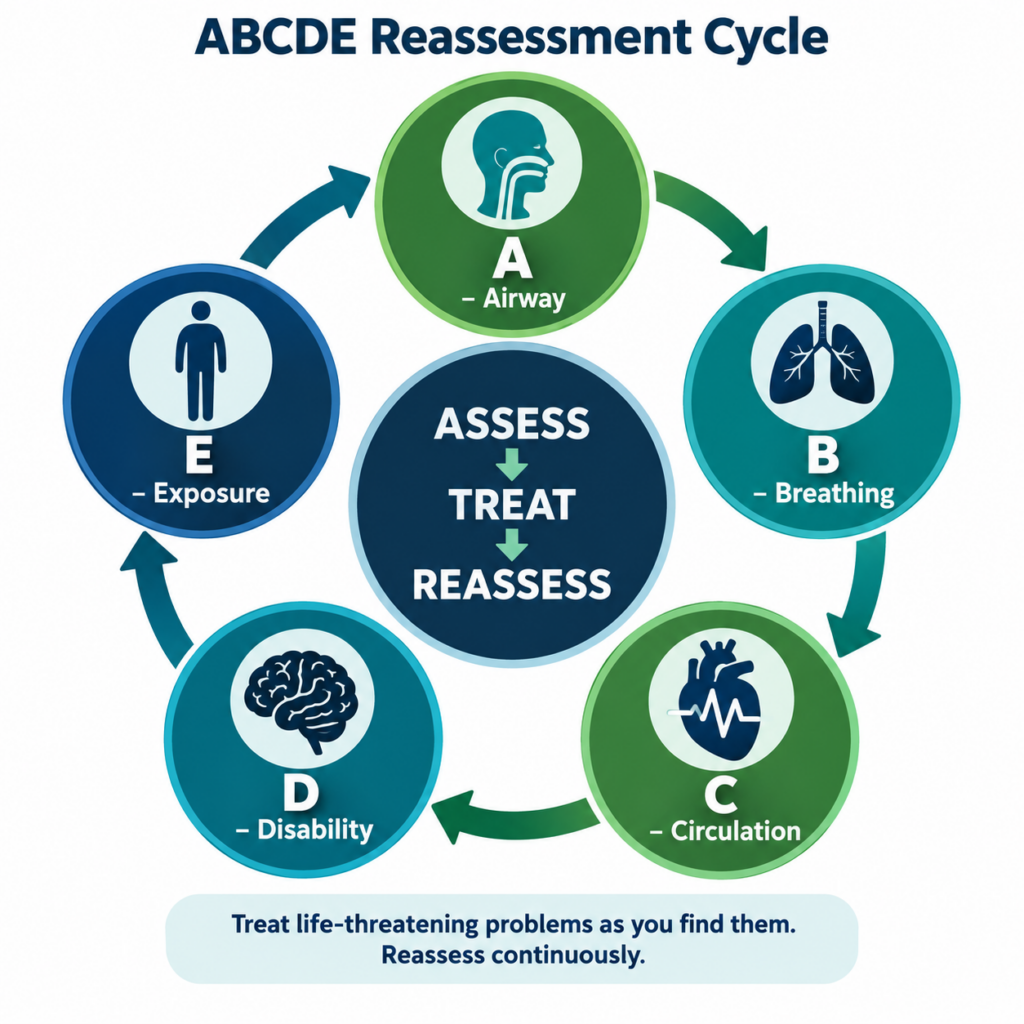
ABCDE is not something you perform once and then forget.
If you identify and treat a problem, check whether the intervention has worked.
If the casualty deteriorates, start again.
Ask yourself:
Is the airway still clear?
Is the person still breathing normally?
Has bleeding restarted?
Has their level of consciousness changed?
Has anything new become apparent?
The person’s condition determines what happens next – not whether you have reached the end of the alphabet.
What happens after the primary survey?
Once immediate life-threatening problems have been identified and managed, a more detailed assessment may follow.
This is often referred to as the secondary survey.
Depending on your training and the circumstances, it could include gathering information about:
- what happened;
- symptoms;
- medical history;
- allergies;
- medication;
- previous medical conditions; and
- injuries discovered during a head-to-toe assessment.
But the secondary survey should never distract you from deterioration.
If the casualty’s condition changes, return to your primary assessment.
Why did RCUK change when you call 999?
The change reflects the difficulty of recognising cardiac arrest.
Previously, basic life-support algorithms commonly required a rescuer to establish that somebody was both unresponsive and not breathing normally before the ambulance call.
The 2025 RCUK Adult Basic Life Support Guidelines changed this.
The guidance now states that rescuers should call 999 for any unresponsive person before determining whether their breathing is normal.
The ambulance service call handler can assist in recognising abnormal breathing and provide CPR instructions.
This is particularly important because cardiac arrest does not always look like somebody lying completely still and taking no breaths.
Agonal gasps, slow or laboured breathing, panting and even a short period of seizure-like activity can occur around the onset of cardiac arrest.
If an unresponsive person’s breathing is abnormal and there is any doubt, RCUK advises assuming cardiac arrest and starting CPR.
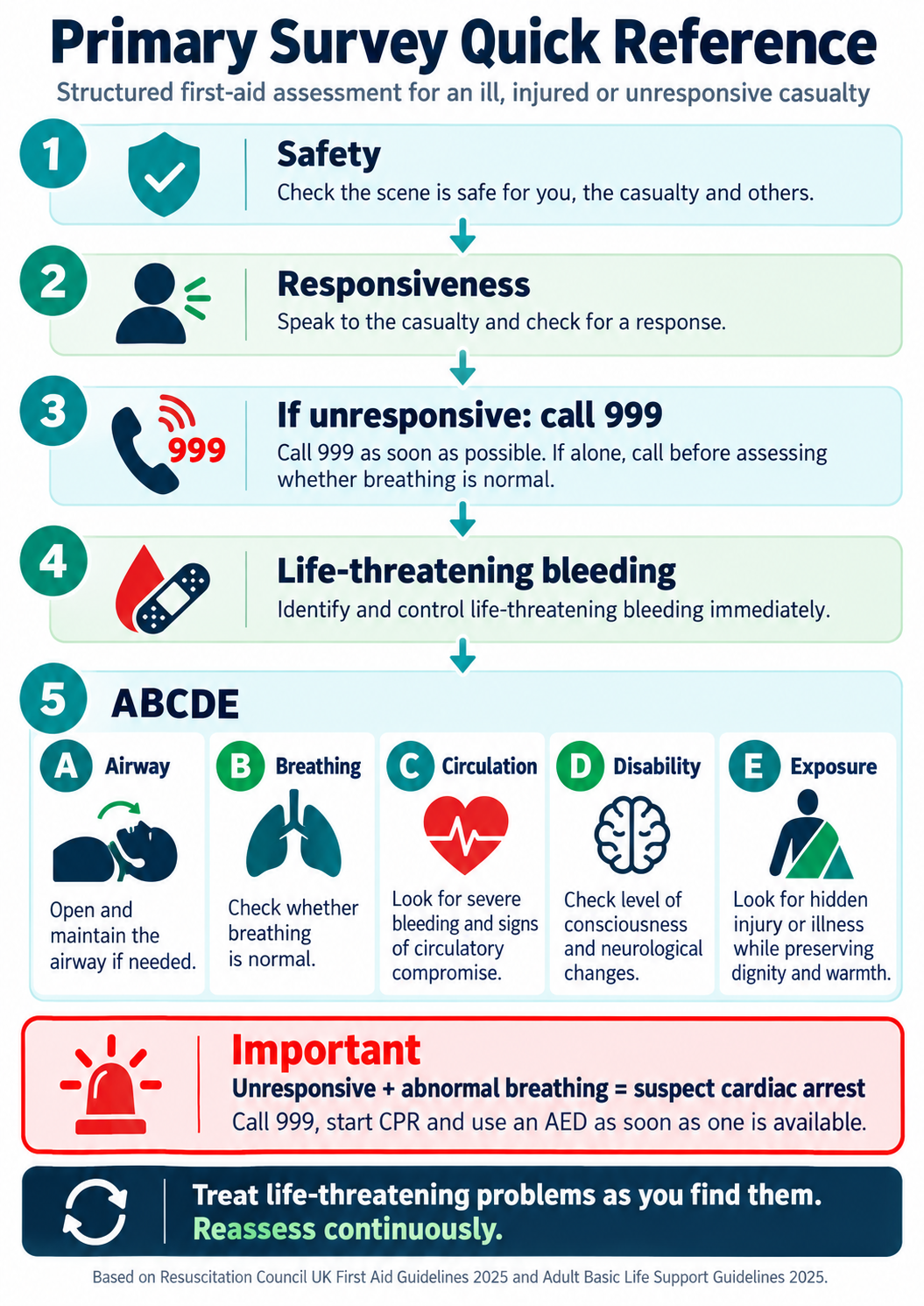
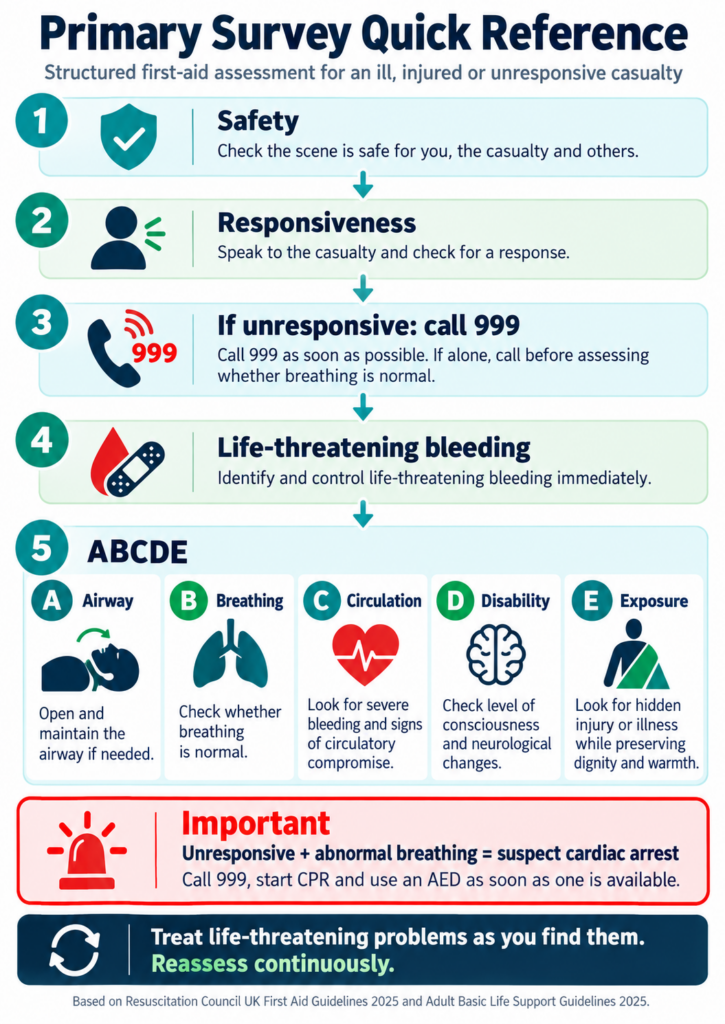
Primary survey: quick-reference table
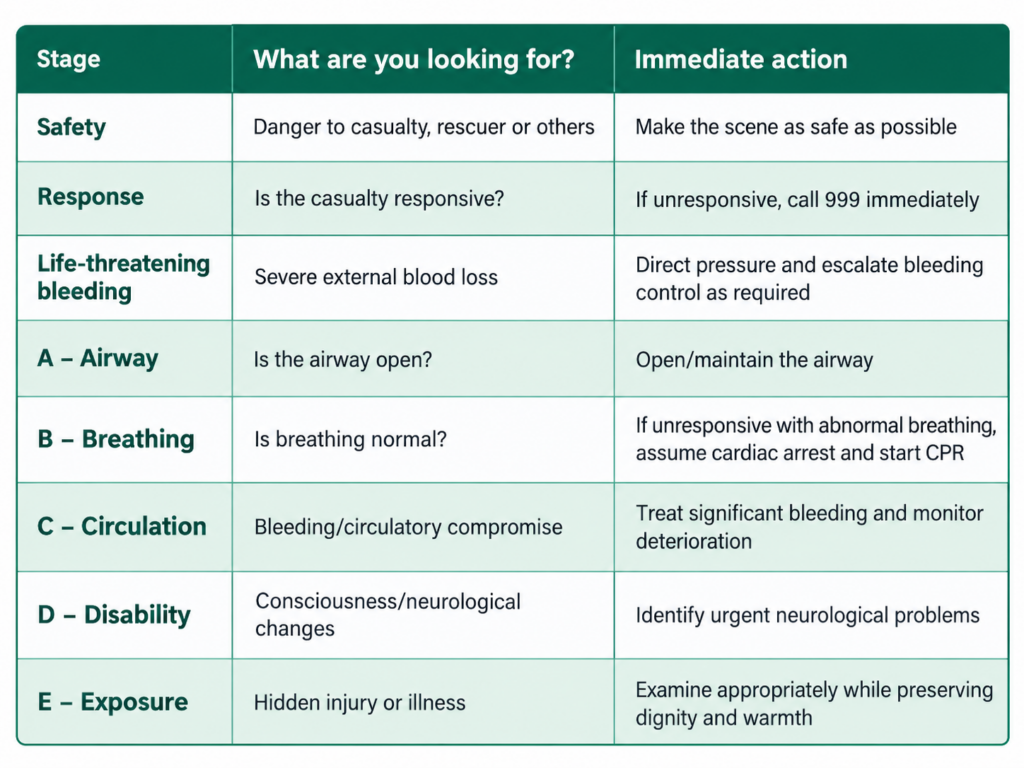
Source: Resuscitation Council UK, First Aid Guidelines 2025 and Adult Basic Life Support Guidelines 2025.
Primary survey quick reference
Keep this guide handy for training, workplace first-aid rooms or refresher sessions.
Sharing this resource: You are welcome to link to this Primary Survey Quick Reference for educational purposes. If you do please credit Team Medic and link back to this page as the original source.
Frequently asked questions
A primary survey is a rapid, structured assessment used to identify and treat conditions that pose an immediate threat to life.
Current RCUK guidance recommends addressing safety, responsiveness and life-threatening bleeding, followed by an ABCDE assessment: Airway, Breathing, Circulation, Disability and Exposure.
ABCDE stands for:
A – Airway
B – Breathing
C – Circulation
D – Disability
E – Exposure
RCUK’s 2025 First Aid Guidelines specifically recommend ABCDE as the framework for structured assessment of an ill, injured or shocked person.
DRABC remains a widely recognised first-aid mnemonic.
However, current RCUK First Aid Guidelines formally recommend an ABCDE structured assessment, while also requiring immediate attention to scene safety, responsiveness and life-threatening bleeding.
The important issue is therefore understanding the priorities behind the assessment rather than treating competing acronyms as entirely different systems.
No – not as an official RCUK acronym.
You may encounter DRSABCDE and similar expanded mnemonics in first-aid or pre-hospital training.
However, RCUK’s published 2025 First Aid Guidelines describe immediate attention to safety, responsiveness and life-threatening bleeding, followed by the ABCDE framework.
This distinction matters when describing the current national guidance accurately.
For an unresponsive person, RCUK’s 2025 Adult Basic Life Support Guidelines advise calling 999 immediately, before determining whether their breathing is normal.
Use speakerphone where possible and assess breathing while waiting for the call to be answered.
Assume that they are in cardiac arrest.
Call 999, start CPR and use an AED as soon as one is available. Follow the instructions of the ambulance service call handler and the AED.
No.
Agonal gasps are an abnormal breathing pattern that can occur in cardiac arrest. RCUK advises that an unresponsive person displaying agonal gasping, slow laboured breathing or other abnormal breathing should be treated as being in cardiac arrest.
Yes
RCUK specifically tells first-aid providers to give immediate attention to life-threatening bleeding before using ABCDE to structure the rest of the casualty assessment.
Medical disclaimer
This article provides general first-aid education and does not replace accredited practical training or advice from a healthcare professional.
In a life-threatening emergency, call 999 and follow the instructions provided by the ambulance service.
Clinical sources and further reading
- Resuscitation Council UK – First Aid Guidelines 2025
Primary clinical source for ABCDE structured assessment, recovery position, life-threatening bleeding, stroke, choking and other first-aid emergencies. RCUK First Aid Guidelines 2025
- Resuscitation Council UK – Adult Basic Life Support Guidelines 2025
Primary source for calling 999 for an unresponsive person, recognition of abnormal breathing, CPR and AED use. RCUK Adult Basic Life Support Guidelines 2025