By Team Medic | UK Private Ambulance and Patient Transport Provider
There’s a question every small ambulance company should ask before investing in its next dispatch system:
Is your software helping you manage your ambulance operation, or are you spending half your day managing the software?
If you run a small or medium-sized private ambulance company, you’ll probably recognise the problem.
A hospital calls with a last-minute discharge. A patient transfer takes longer than expected. A crew needs to be reassigned. Someone wants to know where an ambulance is, and your dispatcher is juggling a booking system, a spreadsheet and several phone calls just to provide an answer.
Sound familiar?
Now imagine handling those changes from one straightforward system, without complicated menus, weeks of training or unnecessary administration.
That was the challenge we faced at Team Medic.
And the solution wasn’t what we originally expected.
The problem with Ambulance Dispatch Software that nobody talks about
Running a private ambulance company is complicated enough.
You’re coordinating patient bookings, managing different vehicle capabilities, allocating crews, accommodating changing hospital discharge times and keeping clients informed.
These are the everyday realities of delivering private ambulance and patient transport services, where effective coordination is essential.
And that’s before you consider contract performance, reporting requirements and the unexpected changes that inevitably arrive throughout the day.
There are plenty of sophisticated ambulance dispatch systems available. Some are designed to support large-scale operations, with extensive functionality and complex workflows.
For larger organisations, that complexity may be justified.
But what about an ambulance company operating five, ten or fifteen vehicles?
Does it really need software designed around the requirements of a much larger organisation?
At Team Medic, we found ourselves facing that very question.
We wanted technology that would make our working day easier, not another system that needed considerable time and effort to master.
The real problem wasn’t necessarily a lack of features. It was the number of steps required to complete everyday tasks.
That distinction became the starting point for something new.
We didn’t start out as a software company.
Built by an Ambulance Company, for Ambulance Companies
We’re Team Medic, an established, CQC-registered private ambulance provider delivering non-emergency patient transport services (NEPTS) and supporting NHS and private healthcare organisations.
Our experience is supported by our CQC registration as a healthcare provider, which covers our regulated ambulance and healthcare activities.
We understand what happens when a hospital changes a discharge time, when a crew becomes delayed or when an additional booking arrives in the middle of an already busy shift.
Our work supporting NHS patient flow and hospital discharges has reinforced just how important effective journey coordination can be.
We also understand the commercial realities of operating a smaller ambulance business.

Margins matter. Staff time matters. And every avoidable administrative task takes attention away from running the operation.
Rather than continue trying to adapt our working arrangements to complicated software, we decided to build something around the way our business actually operates.
That’s how Team Dispatch was born.
Today, Team Dispatch is used within our own patient transport operation.
It isn’t a product conceived solely in a software development environment. Its design comes from the practical requirements of organising real ambulance journeys.
Our aim was straightforward: create ambulance dispatch software that smaller providers could understand, configure and use without unnecessary complexity.
Meet Team Dispatch: patient transport software without the complications
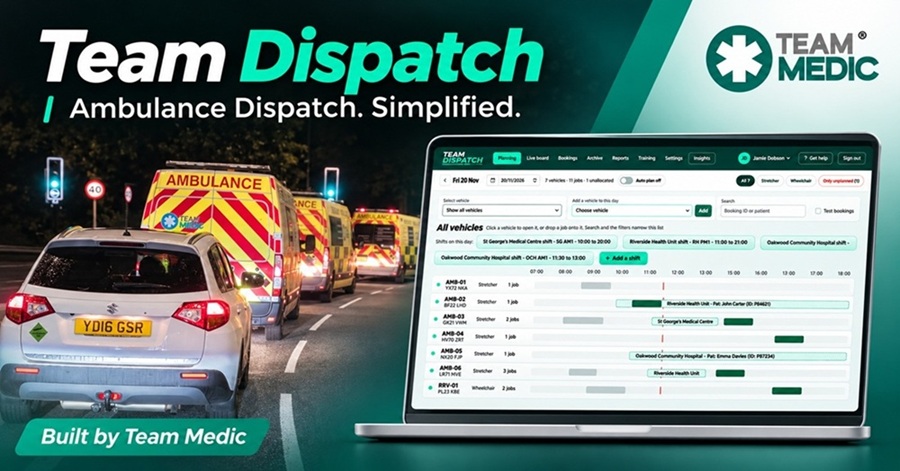
Team Dispatch brings the essential elements of patient transport coordination into one system.
From receiving a booking to allocating a vehicle, updating crew status and reviewing operational performance, the software is designed to make everyday dispatching more manageable.
Here’s what that looks like in practice.
Like what you see? Book a live Team Dispatch demonstration and discover how it could work for your ambulance business.
1. Booking forms that work around your business
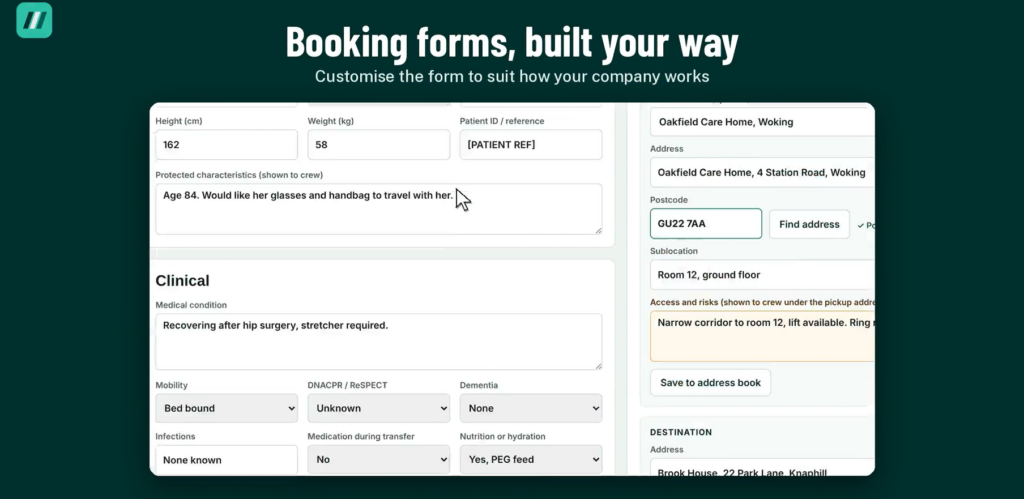
Every ambulance company operates slightly differently.
You may undertake hospital discharges, private patient transfers, wheelchair journeys, stretcher transfers or specialist transport.
Your booking requirements should reflect the services you provide.
Team Dispatch allows you to customise your booking forms around your operation, capturing relevant patient, journey and service information.
Instead of working around a rigid, generic booking process, you can configure the system to suit your business.
The result is a more practical starting point for organising each journey.
2. Drag-and-drop ambulance scheduling
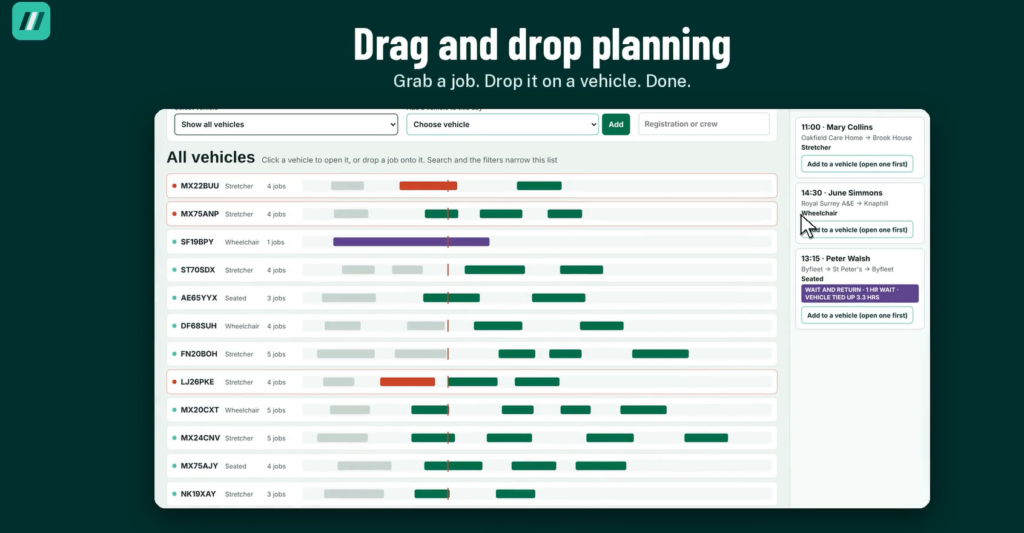
Planning an ambulance fleet can be challenging, particularly when bookings change throughout the day.
A journey overruns. A vehicle becomes available earlier than expected. Another booking needs to be accommodated.
Team Dispatch provides a visual planning board that allows dispatchers to organise and rearrange work using drag-and-drop functionality.
You can see scheduled journeys across your vehicles and make changes without navigating through unnecessarily complicated processes.
For smaller operators, where one person may be managing bookings, allocating vehicles and speaking to clients, keeping that process simple matters.
3. A crew interface designed to be simple
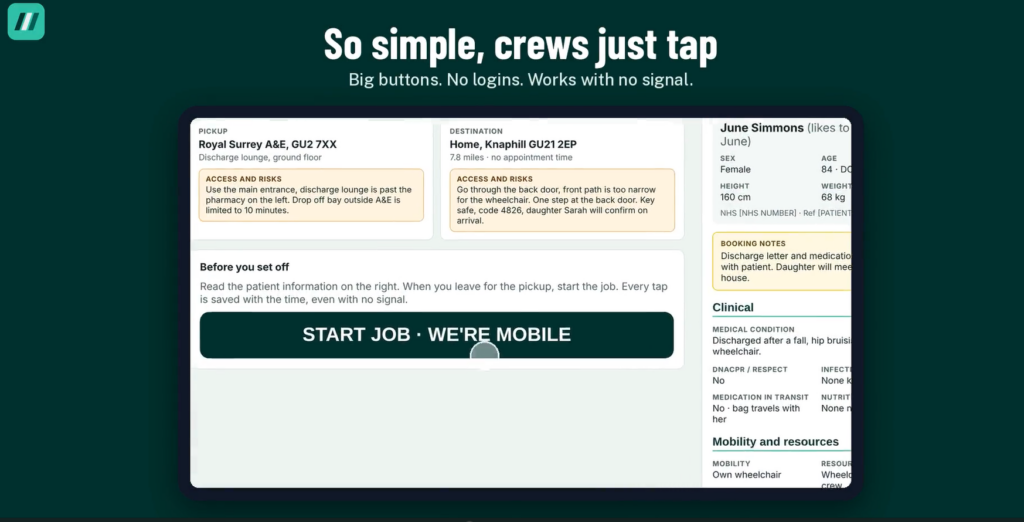
An ambulance crew’s priority should be patient care and safe transport, not navigating a complicated application.
That’s why we’ve kept the Team Dispatch crew interface straightforward.
Crews can access their work using their vehicle code and update their journey progress through simple, clearly labelled buttons.
Whether they’re starting a journey, arriving at a collection point or confirming that a patient is on board, the process is designed to require minimal interaction.
It’s an important distinction.
Good ambulance software shouldn’t make a straightforward task feel complicated.
4. Know where your ambulances are
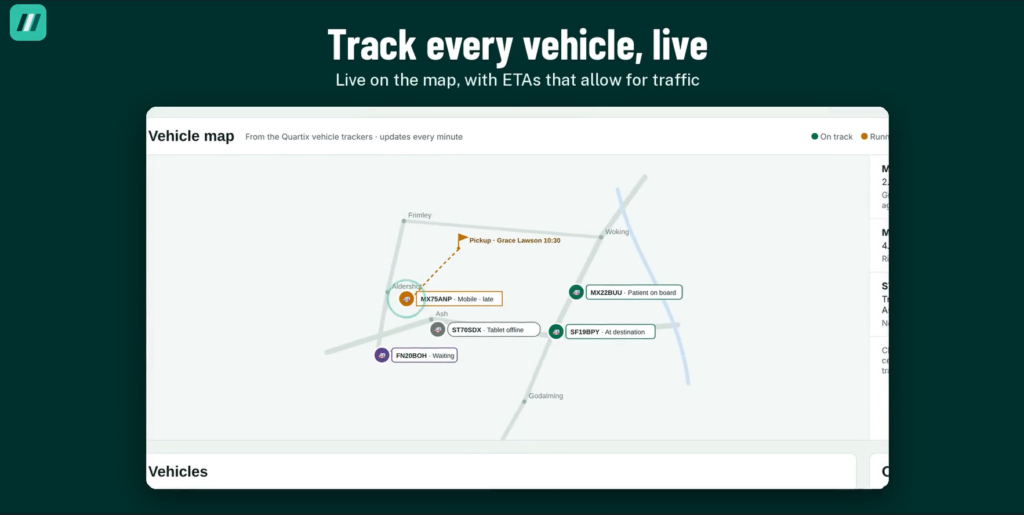
One of the most common questions an ambulance dispatcher receives is also one of the simplest:
“Where’s the ambulance?”
Team Dispatch provides a live vehicle map, giving office staff visibility of their vehicles and journeys.
The system also displays traffic information and estimated arrival times, helping dispatchers understand potential delays and respond to changes.
That information can be particularly useful when coordinating patient collections, hospital discharge teams and time-sensitive transfers.
Rather than relying entirely on phone calls to establish a vehicle’s location, your office team has a clearer picture of what’s happening across the fleet.
We’ve previously explored how live ambulance tracking can improve journey visibility for patients and their families, highlighting why timely location information matters.
5. KPI reporting without the spreadsheet marathon
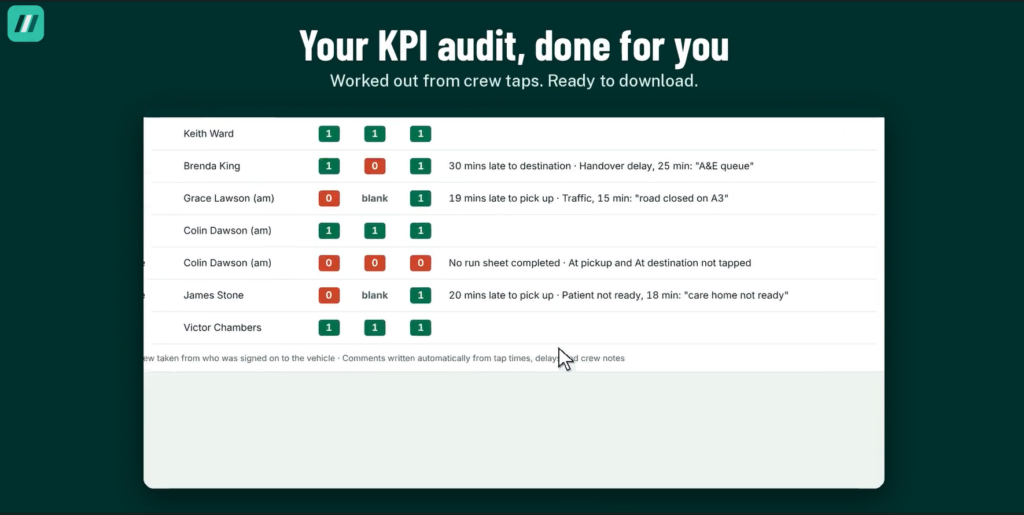
If you provide patient transport services to NHS trusts, hospitals or other contracted clients, you’ll already understand the importance of performance reporting.
Journey times, on-time performance and service delivery information can form an important part of contract management.
The importance of consistent operational reporting is reflected in NHS England’s NEPTS data collection guidance, which includes measures relating to journey activity, timeliness and vehicle utilisation.
But producing those reports shouldn’t mean spending hours reconstructing information from spreadsheets and separate systems.
Team Dispatch includes a KPI reporting dashboard, using recorded journey information to help operators review performance and download reports.
Instead of treating reporting as an entirely separate end-of-month exercise, operational information is captured as part of the dispatch process.
And that brings us to what we believe is one of the most important benefits of a well-designed system.
The biggest improvement isn’t another feature
Here’s what we realised while developing Team Dispatch.
The most useful software isn’t always the software with the longest feature list. It’s the software that removes unnecessary work from your day.
Think about how many times the same piece of journey information is handled.
A booking arrives. Someone enters the details. A dispatcher allocates the journey. The crew receives instructions. The office monitors progress. Later, somebody needs the information for a report.
If those activities are disconnected, staff can find themselves repeating work, chasing updates or transferring information between systems.
Team Dispatch is designed to connect those everyday operational steps.
For a small ambulance company, that simplicity is particularly valuable.
You may not have a dedicated IT department or a large control room. Your operations manager might also be dealing with staff availability, customer enquiries and vehicle requirements.
You need a system that supports the business you actually run.
Not one that expects you to become a software specialist.
What should small ambulance companies look for in dispatch software?
Before choosing an ambulance scheduling system, it’s worth looking beyond the sales presentation.
Consider how easily your office staff can create and amend bookings. Look at how crew members receive and update their work. Ask whether the system provides the vehicle visibility your operation needs.
Reporting is another important consideration. Can you access useful operational information without rebuilding the data manually?
You should also establish how the supplier manages sensitive booking information, what support is available, how your existing records could be transferred and what the total cost would be. Patient information requires particular consideration. The ICO’s guidance on special category data explains the additional safeguards required when processing personal health information.
No two ambulance companies operate in exactly the same way, so any software demonstration should reflect your actual workflows.
These are the questions we believe operators should be asking, regardless of which product they’re considering.
Why we believe Team Dispatch is different
There is one distinction we’re particularly proud of.
The people behind Team Dispatch also understand the responsibilities of operating an ambulance company.
At Team Medic, we work in the same industry as the businesses we’re trying to help.
Our operational background includes delivering patient transport services and securing a place on the NHS Shared Business Services patient transport framework, giving us direct insight into the expectations placed on ambulance providers.
We understand the operational pressures, the need for accurate journey information and the importance of having dependable processes.
We also know that smaller providers need to make careful decisions about where they invest their money and their staff’s time.
Team Dispatch was developed with those realities in mind.
We haven’t tried to make it everything to everyone.
We’ve focused on making the core processes of patient transport booking, planning, dispatching, tracking and reporting easier to manage. You can explore the full range of Team Dispatch features to see how the software supports these everyday operational tasks.
And because we use the system in our own patient transport operation, we’re approaching its development from the perspective of an ambulance provider as well as a software supplier.
Frequently Asked Questions
Ambulance dispatch software helps operators manage patient transport bookings, allocate vehicles and crews, coordinate journeys and monitor operational activity. Depending on the system, it may also provide live vehicle tracking, scheduling tools and performance reports.
Team Dispatch has been designed specifically with small and medium-sized ambulance and patient transport providers in mind. It focuses on straightforward booking management, visual planning, simple crew interaction and operational reporting.
Yes. Team Dispatch was developed around patient transport operations, including the types of scheduled and ad hoc journeys managed by private ambulance providers delivering NEPTS.
Team Dispatch includes a live vehicle map, allowing dispatchers to view vehicle locations and journey information. It also provides traffic information to help teams monitor potential delays.
The system includes a KPI reporting dashboard using recorded journey information. Operators can review performance information and download reports to support their internal and contractual reporting processes. Specific reporting requirements should be discussed during a demonstration.
See what happens when dispatch software is built around your business
If you’re running a smaller ambulance company, you probably didn’t start your business because you wanted to spend your evenings sorting spreadsheets, chasing journey updates or learning complicated software.
You started it to provide a service.
Your dispatch system should help you deliver that service efficiently, without creating unnecessary work along the way.
That’s the thinking behind Team Dispatch.
Simple booking. Straightforward planning. Clear crew updates. Live vehicle visibility. Practical reporting.
All designed around the everyday requirements of a smaller patient transport operation.
We’ve built a system we wanted to use ourselves.
Now we’d like to show you what it could do for your business.
Ready to make ambulance dispatch simpler?
Watch our short product demonstration and see Team Dispatch in action.
Better still, book a live demo and let us show you how it could work with your own vehicles, crews and booking requirements.
Ready to simplify your ambulance operations? Book your free Team Dispatch demonstration and see how the software could fit your vehicles, crews and patient transport workflows.
Team Dispatch is developed by Team Medic (London) Ltd, a CQC-registered UK ambulance provider. Team Medic’s CQC registration relates to its regulated healthcare services, not certification or endorsement of the Team Dispatch software.